
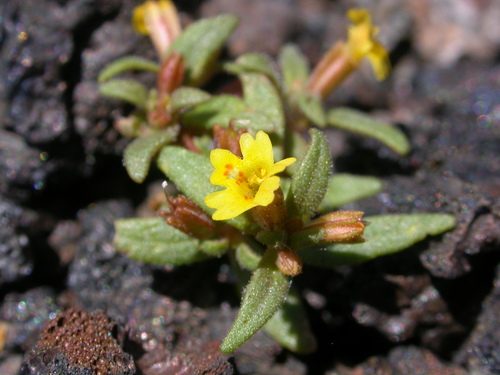


Miniature Monkeyflower
erythranthe suksdorfii
The Miniature Monkeyflower (Erythranthe suksdorfii) is a delightful, pint-sized annual wildflower native to the rugged landscapes of western North America. Typically growing no taller than a few centimeters, this species makes up for its small stature with its brilliantly colored, tubular yellow flowers that often sport tiny red speckles inside their throats. It is a specialist of ephemeral moist habitats, germinating, blooming, and setting seed in a rapid race against the summer sun. Historically placed in the genus Mimulus, this plant showcases the remarkable adaptability of the family Phrymaceae. Botanists and hikers alike delight in spotting these tiny blossoms, which often form miniature golden carpets over damp volcanic soils and rocky seeps.
Habitat: Found in moist vernal seeps, damp sandy or gravelly flats, and montane slopes, often on volcanic or basaltic soils.
This diminutive herb stands only 2 to 10 centimeters tall, featuring simple or branched stems covered in sticky, glandular hairs. The small, opposite leaves are oval to elliptic, often tinged with a reddish-purple hue on their undersides. Its solitary, bilateral flowers are bright yellow, measuring only 4 to 8 millimeters long. The funnel-shaped corolla is slightly two-lipped, with a throat that is commonly hairy and adorned with tiny, delicate red spots that guide pollinators.
Category
PlantsRarity
Common
Danger
1/5 · Very low
Snaps
Be the first to snap!
Its scientific genus name Erythranthe translates to 'red flower', a bit ironic given that this species is known for its bright yellow blossoms.
The tiny red spots inside the flower's throat act as 'nectar guides', directing bees straight to the nectar reward while ensuring pollination.
This species is so small that a fully mature, flowering plant can easily fit on the tip of a human finger.
The plant quickly germinates, blooms, and produces seeds within a brief spring window before its moist habitat completely dries out.
Stems and leaves are coated with sticky, glandular hairs that deter small herbivorous insects from crawling up the plant.
It is adapted to thrive in nutrient-poor, mineral-heavy soils derived from basalt and volcanic ash where other plants struggle.
As a photoautotrophic plant, it produces energy using chlorophyll to capture sunlight, converting carbon dioxide and water into vital sugars.
Bombus bifarius
Bumblebees visit the tubular yellow flowers to collect nectar, acting as key pollinators.
Euphydryas chalcedona
Caterpillars of this checkerspot butterfly feed on the leaves and stems of monkeyflowers.

Ovis canadensis
Foraging sheep may occasionally ingest these plants while grazing on sparse, moist mountain slopes.
No trait badges are assigned for this object yet.
No aliases listed yet.
Collections for this object will appear here as more themes are added.
Danger
1/5 · Very low
No special safety notes yet.
Start with the whole plant, then compare leaf arrangement, leaf edges, stems and any flowers or fruit. Opposite leaves grow in pairs; alternate leaves come one at a time along the stem. These details tell you far more together than a single green leaf does. Plant Identifier: upload a photo and compare the visible details.
2+ cm
0.001+ kg
As a photoautotrophic plant, it produces energy using chlorophyll to capture sunlight, converting carbon dioxide and water into vital sugars.
Found in moist vernal seeps, damp sandy or gravelly flats, and montane slopes, often on volcanic or basaltic soils.
Zoom in to split clusters and explore where this object has been snapped.
Recent snaps will appear here as new observations are added.
Take the discovery with you
Snap it with Snappit to identify it, learn what makes it special, and add the discovery to your collection.


















