





Bighorn Sheep
Ovis canadensis
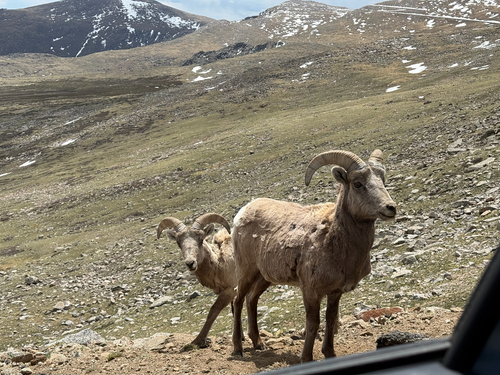
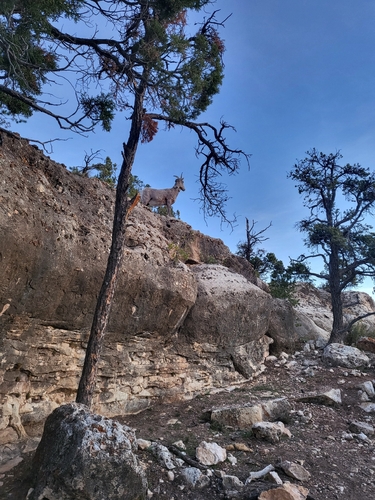
Bighorn sheep are strong animals with big, curved horns. They love to climb rocky mountains and can jump very high!
Habitat: Mountainous areas
The Bighorn Sheep has a short, brownish-grey coat, typically lighter on its belly and rump. Males are characterized by massive, tightly curled horns, while females have smaller, more slender, less curved horns. Their stocky build and split hooves distinguish them in rocky environments.
Category
MammalsRarity
Common
Danger
2/5 · Low
Snaps
74
Bighorn sheep use their keen sense of smell to find water hidden under snow.
Male bighorns clash horns at 32 km/h, making a sound heard a mile away!
Their massive horns can weigh over 14 kg, as much as all the bones in their body!
They can navigate narrow ledges only 5 centimeters wide without falling!
Bighorn Sheep can scale steep, rocky cliffs with ease because of their specialized hooves that provide exceptional grip.
Bighorn Sheep has incredibly strong skulls and massive horns that help them settle dominance disputes with powerful head-butts.
Bighorn Sheep has unique respiratory and circulatory systems that help them thrive in thin, high-altitude air.
These agile mountain herbivores munch on plants, finding food even in harsh, rocky environments.
Furry describes animals possessing a dense covering of soft hair or fur.
Social animals live in organized groups, cooperating for survival benefits such as foraging, defense, and raising offspring.
Characterized by having one or more hard, permanent, pointed projections on the head.
This trait characterizes organisms whose diet consists entirely or primarily of plant material.

This habitat trait identifies species found in mountainous regions, characterized by high elevation, steep slopes, and varying climate zones.

Describes a species whose presence and role have a disproportionately large effect on its environment.

This trait identifies organisms that exhibit exceptional swiftness in movement for hunting, escape, or travel.

Nocturnal animals are primarily active during the nighttime hours, typically resting or sleeping during the day.
Danger
2/5 · Low
Always watch bighorn sheep from a distance. They are wild animals and need their space.
The easiest way to identify Bighorn Sheep is to use the Snappit nature identifier app.
150-180 cm
50-140 kg
10-14 years
48 km/h
These agile mountain herbivores munch on plants, finding food even in harsh, rocky environments.
Mountainous areas
Grazing
Zoom in to split clusters and explore where this object has been snapped.
Jun 6, 2026
Summit Lake ParkPhoto attribution
(c) Jared Lincenberg, some rights reserved (CC BY)
License: CC BY 4.0 ↗
Image may be shown cropped inside the card frame.
Mar 17, 2026
Grand Canyon Inn and CampgroundPhoto attribution
(c) travis b thurber, some rights reserved (CC BY)
License: CC BY 4.0 ↗
Image may be shown cropped inside the card frame.

Colorado, US
You might spot Common Side-Blotched Lizard and Eastern Collared Lizard.
View guide →

Colorado, US
You might spot Rocky Mountain Marsh-Marigold and American Bistort.
View guide →

Montana, US
You might spot Bighorn Sheep and Curlleaf Mountain Mahogany.
View guide →
Washington, US
You might spot Elk, American Bison, and Mountain Goat.
View guide →

South Dakota, US
You might spot Japanese Macaque, Tiger, and Snow Leopard.
View guide →

Utah, US
You might spot Polar Bear, Gorilla, and Bornean Orangutan.
View guide →
Take the discovery with you
Snap it with Snappit to identify it, learn what makes it special, and add the discovery to your collection.







.jpg&width=800)



.JPG&width=800)


.jpg&width=800)
