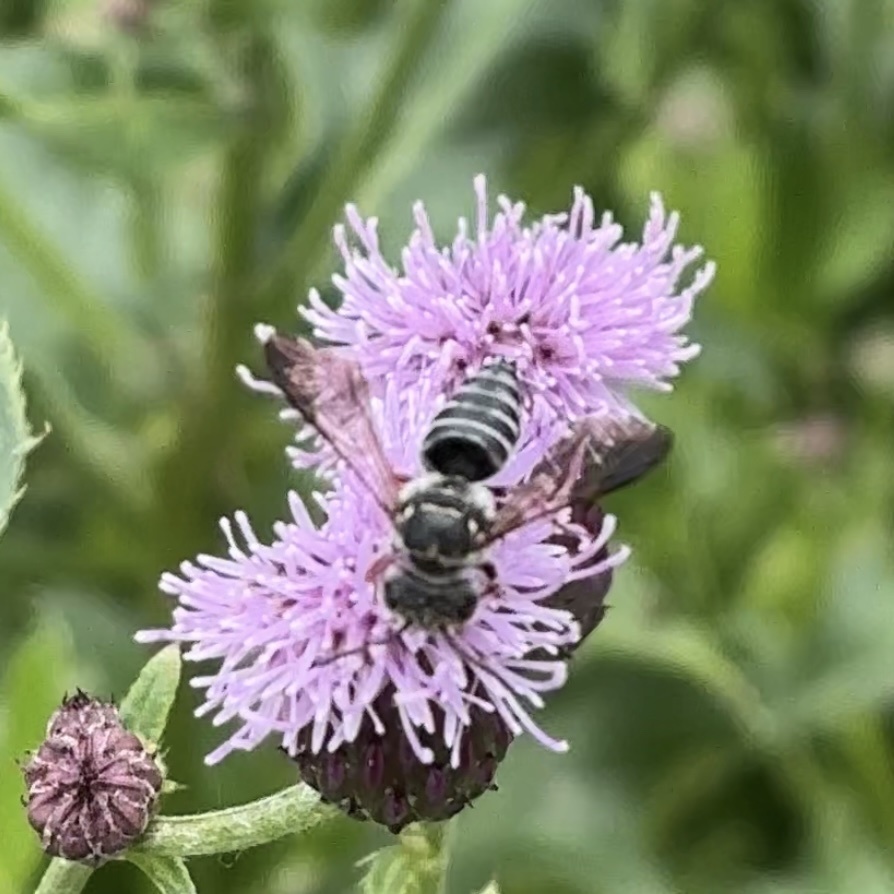





Modest Sharptail
Coelioxys modestus
The Modest Sharptail is a special kind of bee that loves to visit flowers. It helps plants grow by spreading pollen while it collects nectar. These bees are small and have a unique shape that makes them stand out!
Habitat: Urban areas, Gardens
The Modest Sharptail is a slender, black bee with a shiny, pointed abdomen featuring narrow, pale bands of hair. Its body has sparse, light hairs, giving it a more wasp-like appearance compared to fuzzy bees.
Category
InsectsRarity
Common
Danger
1/5 · Very low
Snaps
Be the first to snap!
Female Modest Sharptails have a very pointy tail, like a tiny hardened spear!
Modest Sharptails don't build their own nests, they sneak into other bees' homes!
Their babies grow by eating the food collected by other hard-working mother bees!
These sneaky bees don't collect pollen themselves; they just steal it!
Modest Sharptail can lay its eggs in other bees' nests because its larvae will steal their food, helping them survive.
Modest Sharptail has a tough, conical abdomen that helps them break into host nests or defend against rivals.
Modest Sharptail can lay eggs that mimic the host's eggs, helping them go undetected in foreign nests.
These sneaky bees steal pollen and nectar gathered by other bees to feed their young.
Age differences: Larvae consume host bee's stored food and sometimes host eggs/larvae, while adults feed on nectar from flowers.

Megachile campanulae
Lays eggs in their nests and steals their food stores.
Megachile texana
Their young grow by consuming this bee's stored pollen.
Trifolium repens
Adults drink nectar from its flowers for energy.
Social animals live in organized groups, cooperating for survival benefits such as foraging, defense, and raising offspring.
Colorful describes organisms or objects displaying a wide range of bright and distinct colors.
This trait characterizes organisms whose diet consists entirely or primarily of plant material.
Describes plants that are particularly attractive and beneficial to a wide range of pollinating organisms.
Diurnal animals are primarily active during daylight hours, typically resting or sleeping at night.
Pertaining to species that are significantly smaller than typical or average for their kind.
This habitat trait indicates species that can coexist with humans in urban and suburban environments, utilizing man-made structures and green spaces.
Describes organisms that transfer pollen, enabling the fertilization and reproduction of plants.
No aliases listed yet.
Danger
1/5 · Very low
Stay calm and still if you see a bee; they usually won't bother you.
Look for six legs, antennae, three body sections and the shape of the wings. Beetles have hardened front wings; flies have just one working pair. Tiny insects may need a close view before their group is clear. Insect Identifier: upload a photo and compare the visible details.
15-25 mm
7-12 mm
30-60 days
12 km/h
These sneaky bees steal pollen and nectar gathered by other bees to feed their young.
Urban areas, Gardens
6
Zoom in to split clusters and explore where this object has been snapped.
Recent snaps will appear here as new observations are added.
Take the discovery with you
Snap it with Snappit to identify it, learn what makes it special, and add the discovery to your collection.