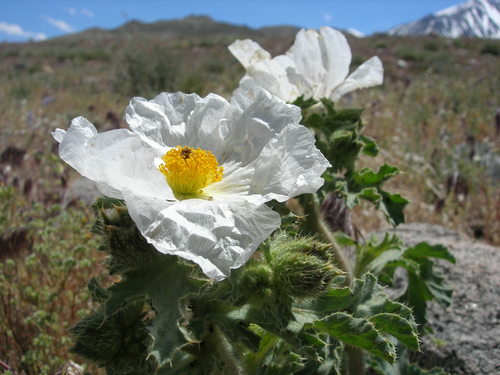


Mojave Prickly Poppy
argemone corymbosa
The Mojave Prickly Poppy is a resilient and striking perennial herb that brings a touch of delicate elegance to the harsh, arid environments of the southwestern United States. Standing out against the muted tones of the desert, this plant produces large, paper-thin white flowers with brilliant golden-yellow centers. Despite its fragile-looking blossoms, the plant is heavily armed with sharp, needle-like prickles covering its stems and leaves, serving as an effective deterrent against thirsty desert herbivores. This striking contrast makes it a favorite among desert hikers and photographers. Beyond its visual appeal, the Mojave Prickly Poppy is a vital component of its ecosystem, offering pollen to native bees and other desert insects. Its ability to thrive in poor, sandy, and gravelly soils where other plants struggle showcases its incredible evolutionary adaptations to extreme drought and heat.
Habitat: Found in dry, sandy washes, gravelly slopes, and open desert scrub communities of the Mojave Desert.
This plant typically grows as an upright, multi-stemmed herb reaching 40 to 80 centimeters in height. Its most defining features are its showy, three-inch-wide flowers featuring 4 to 6 crinkly, snow-white petals surrounding a dense dome of bright yellow stamens. The foliage is pale blue-green, deeply lobed, and heavily armed with sharp, yellowish spines along the margins and veins. When any part of the stem or leaf is broken, it secretes a thick, bright yellow-to-orange latex sap.
Category
PlantsRarity
Common
Danger
1/5 · Very low
Snaps
Be the first to snap!
Despite its delicate, paper-thin petals, this plant is exceptionally tough and thrives in scorching temperatures exceeding 100 degrees Fahrenheit.
The bright yellow latex sap of the prickly poppy was historically used by Indigenous peoples for various medicinal purposes, including treating skin spots.
The seeds of this species can remain dormant in dry desert soil for years, waiting for the perfect rainfall before germinating.
The plant produces a toxic, bright yellow latex sap rich in alkaloids that deters herbivores from consuming its tissues.
Its leaves are covered in a glaucous, waxy coating that reduces water loss and reflects intense desert sunlight.
Extremely sharp spines cover nearly every surface of the stems and leaves, preventing physical damage from foraging animals.
As a photosynthetic plant, the Mojave Prickly Poppy generates its own food using sunlight, water, and carbon dioxide.
Agapostemon texanus
Pollinated by native desert bees seeking pollen from the prominent yellow stamens.
Hyles lineata
Pollinated by nocturnal and crepuscular moths attracted to the large white blossoms.
Pogonomyrmex desertorum
Fallen seeds are gathered and consumed by desert ants, aiding in localized seed dispersal.
No trait badges are assigned for this object yet.
No aliases listed yet.
Collections for this object will appear here as more themes are added.
Danger
1/5 · Very low
No special safety notes yet.
Start with the whole plant, then compare leaf arrangement, leaf edges, stems and any flowers or fruit. Opposite leaves grow in pairs; alternate leaves come one at a time along the stem. These details tell you far more together than a single green leaf does. Plant Identifier: upload a photo and compare the visible details.
40-80 cm
0.1-0.6 kg
1-3 years
As a photosynthetic plant, the Mojave Prickly Poppy generates its own food using sunlight, water, and carbon dioxide.
Found in dry, sandy washes, gravelly slopes, and open desert scrub communities of the Mojave Desert.
Zoom in to split clusters and explore where this object has been snapped.
Recent snaps will appear here as new observations are added.
Take the discovery with you
Snap it with Snappit to identify it, learn what makes it special, and add the discovery to your collection.