

Musk Lorikeet
trichoglossus concinnus
The Musk Lorikeet is a lively, highly energetic parrot native to south-eastern Australia. Renowned for their gregarious and nomadic lifestyle, these small green parrots travel in noisy, fast-moving flocks, constantly searching for flowering eucalyptus trees. They are closely linked to the canopy of dry sclerophyll forests, where their boisterous calls and active foraging behavior bring the treetops to life. In addition to natural woodlands, they have adapted remarkably well to urban areas, frequently visiting suburban parks and gardens rich in flowering native flora. What makes them particularly fascinating is their specialized diet, which relies heavily on nectar and pollen. Their presence is a vital component of their ecosystem, serving as key pollinators for many native Australian tree species. Their social nature means they are rarely seen alone, often feeding alongside other lorikeet species in noisy, colorful feeding frenzies.
Habitat: Typically found in dry sclerophyll forests, open eucalyptus woodlands, and suburban parks throughout southeastern Australia.
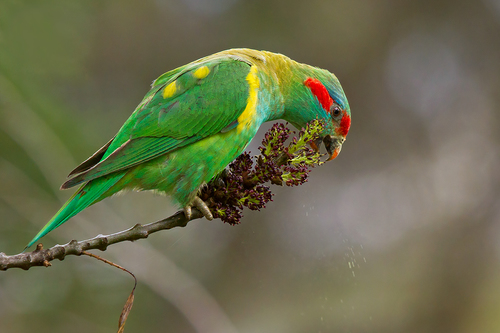
Measuring about 22 centimeters in length, the Musk Lorikeet is predominantly bright green with a distinctive, bright red band running across its forehead and through its eyes to the ears. The crown of its head features a soft blue wash, while its mantle and underwings have a subtle olive-yellow tint. In flight, they present a streamlined silhouette with pointed wings and a narrow, wedge-shaped tail, often revealing flashes of yellow on the sides of the tail and under the wings. Their small, stout beak is dark brown to black with a bright orange-red tip, which contrasts sharply with their green and red plumage.
Category
BirdsRarity
Common
Danger
1/5 · Very low
Snaps
Be the first to snap!
Because they feed on fermenting nectar, they can occasionally become disoriented or show signs of mild intoxication after consuming overripe, fermenting blossoms.
They get their common name from their sweet, musk-like scent, which is particularly noticeable in nesting hollows or when their feathers are damp.
Unlike many parrots, they are highly nomadic, constantly traveling in screeching flocks to track down patchily distributed flowering events across the landscape.
Equipped with tiny, brush-like papillae on the tip of the tongue to efficiently mop up nectar and pollen from blossoms.
Possesses strong, grasping feet that allow them to hang completely upside down to reach difficult flowers at the ends of thin branches.
Capable of high-speed, direct flight to efficiently traverse vast distances in search of unpredictably blooming eucalyptus forests.
Feeds predominantly on nectar and pollen harvested from flowering eucalyptus trees, supplemented with native fruits and seeds.
Eucalyptus melliodora
Feeds on the nectar and pollen of the flowers, aiding in the pollination of this key native tree.

Trichoglossus moluccanus
Competes directly for food resources and nesting hollows in overlapping urban and woodland habitats.

Falco peregrinus
Preys on adult lorikeets in mid-air through high-speed aerial pursuits.
No trait badges are assigned for this object yet.
No aliases listed yet.
Collections for this object will appear here as more themes are added.
Danger
1/5 · Very low
No special safety notes yet.
Compare the silhouette, bill shape, tail length, wing bars and markings around the eyes. The same small brown bird at your feeder can look quite different in breeding plumage, winter plumage or its first year. Bird Identifier: upload a photo and compare the visible details.
20-23 cm
32-38 cm
0.05-0.09 kg
10-20 years
65 km/h
Feeds predominantly on nectar and pollen harvested from flowering eucalyptus trees, supplemented with native fruits and seeds.
Typically found in dry sclerophyll forests, open eucalyptus woodlands, and suburban parks throughout southeastern Australia.
Zoom in to split clusters and explore where this object has been snapped.
Recent snaps will appear here as new observations are added.
Take the discovery with you
Snap it with Snappit to identify it, learn what makes it special, and add the discovery to your collection.