

Narrowleaf Mountainmint
pycnanthemum tenuifolium
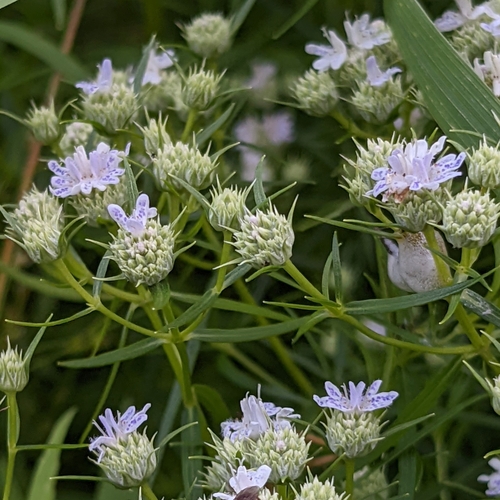
Narrowleaf Mountainmint (Pycnanthemum tenuifolium) is a visually striking and exceptionally fragrant herbaceous perennial belonging to the mint family. Unlike many familiar mints that boast broad leaves, this species lives up to its common name with exceptionally fine, needle-like foliage that creates a soft, airy texture in the wild. Native to eastern and central North America, it is renowned as a true pollinator powerhouse, acting as a magnet for an incredible diversity of bees, butterflies, and beneficial wasps during its mid-to-late summer bloom. Its powerful minty fragrance is released whenever the leaves are brushed or crushed by passing wildlife, adding a sensory delight to wild meadows, prairies, and native gardens alike.
Habitat: Found in dry to moist open woods, tallgrass prairies, fields, and rocky upland glades, typically thriving in areas with abundant sunlight.
This erect, multi-branched herbaceous plant typically reaches 60 to 90 centimeters (2 to 3 feet) in height. It is easily identified by its extremely narrow, linear, and smooth-edged (entire) leaves that are almost needle-like, growing opposite each other on stiff, hairless, square stems. In mid-to-late summer, the stems are topped with dense, flat-topped terminal clusters (corymbs) of tiny, tubular, two-lipped white flowers, which are often delicately speckled with faint purple or pink spots. The overall appearance is a wispy, light green, bushy herb capped with snow-like floral heads.
Category
PlantsRarity
Common
Danger
1/5 · Very low
Snaps
2
Despite its delicate, airy appearance, crushing the needle-like leaves of this plant releases a powerful minty fragrance that rivals carefully cultivated culinary mints.
It is widely considered one of the absolute best plants for attracting insect biodiversity; a single patch can host dozens of different species of bees, butterflies, moths, and wasps at the same time.
Native Americans historically used teas made from the fragrant leaves of the Narrowleaf Mountainmint to treat fevers, colds, and digestive issues.
Unlike true mints in the genus Mentha, Narrowleaf Mountainmint is clump-forming and less aggressively invasive in garden settings, making it a much more polite neighbor to other plants.
Produces an extraordinary abundance of high-quality nectar, making it a highly efficient and vital food resource for a vast array of pollinating insects during the intense heat of late summer.
Contains potent aromatic essential oils, notably pulegone, which naturally deter deer, rabbits, and other mammalian herbivores from browsing its foliage.
Features deep, fibrous root systems and narrow leaves that minimize water loss, allowing the plant to thrive in dry, rocky soils and survive prolonged drought periods.
As an autotrophic plant, Narrowleaf Mountainmint produces its own food through the process of photosynthesis.

Danaus plexippus
Relies heavily on the plant's abundant nectar during late summer migrations and breeding.
Sphex pensylvanicus
Frequently visits the tiny white flowers to feed on nectar, while inadvertently pollinating the plant.
Bombus impatiens
An active and common pollinator that gathers both nectar and pollen from the dense flower clusters.
No trait badges are assigned for this object yet.
No aliases listed yet.
Collections for this object will appear here as more themes are added.
Danger
1/5 · Very low
No special safety notes yet.
The easiest way to identify Narrowleaf Mountainmint is to use the Snappit nature identifier app.
60-90 cm
3-10 years
As an autotrophic plant, Narrowleaf Mountainmint produces its own food through the process of photosynthesis.
Found in dry to moist open woods, tallgrass prairies, fields, and rocky upland glades, typically thriving in areas with abundant sunlight.
Zoom in to split clusters and explore where this object has been snapped.
Virginia, US
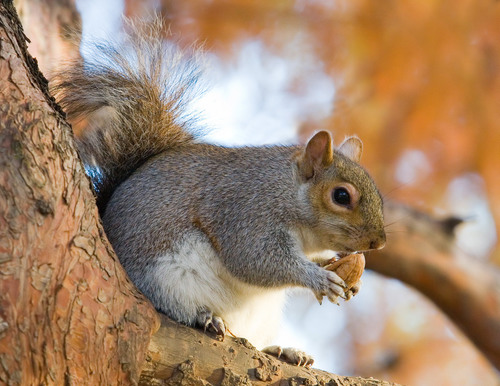
You might spot Eastern Gray Squirrel and Spotted Lanternfly.
View guide →

Alabama, US
You might spot Northern Mockingbird, Snapping Turtle, and Rabidosa.
View guide →

Virginia, US
You might spot Eastern Box Turtle and Carolina Horsenettle.
View guide →
Take the discovery with you
Snap it with Snappit to identify it, learn what makes it special, and add the discovery to your collection.












.jpg&width=800)



_001.jpg&width=800)




