
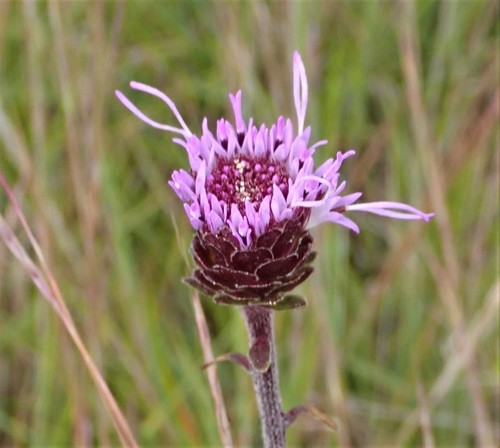


New England Blazing Star
liatris novae-angliae
The New England Blazing Star (Liatris novae-angliae) is a rare and striking perennial wildflower native to the northeastern United States. Standing tall in open, sandy habitats like sandplains and coastal grasslands, this plant bursts into vibrant bloom during late summer and early fall. Its vivid magenta-purple flowers provide a crucial late-season nectar source for a variety of pollinators, particularly native bees and migratory butterflies preparing for their long journeys. Unfortunately, due to habitat loss, urban development, and fire suppression, this beautiful species has become increasingly rare across its native range. Conservation efforts are currently underway to restore the open, sandy habitats it requires to thrive, ensuring that this native 'blazing star' continues to light up the New England landscape.
Habitat: Found primarily in dry, open, sandy or rocky soils, such as sandplain grasslands, pitch pine-scrub oak barrens, and coastal heathlands.
The New England Blazing Star is a herbaceous perennial featuring stiff, erect, and unbranched stems reaching 30 to 90 centimeters (1 to 3 feet) in height. Its leaves are narrow, grass-like, and alternate along the stem, becoming progressively smaller toward the top. The most striking visual identifier is its inflorescence: a terminal, spike-like cluster of fuzzy, magenta-purple (and very rarely white) flower heads. Uniquely, like all Liatris species, the flowers bloom from the top of the spike downward, creating a vibrant, tufted wand effect.
Category
PlantsRarity
Common
Danger
1/5 · Very low
Snaps
Be the first to snap!
It is a fire-dependent species; without natural brush fires to clear out taller trees and shrubs, the plant eventually gets shaded out and disappears from the landscape.
Many species of Liatris have underground corms that were historically used by Native American tribes for medicinal purposes, though this specific species is now far too rare to forage safely.
The genus name Liatris has unknown origins, but the common name 'Blazing Star' perfectly captures the vibrant, star-like appearance of their bright purple flower heads.
Unlike most spike-blooming flowers like snapdragons or foxgloves, which bloom from the bottom up, Blazing Stars bloom backwards from the top down.
Unlike most spike-flowering plants that open from the bottom up, this species blooms from the top down, a distinctive trait of its genus.
Its deep underground corm and narrow, moisture-conserving leaves allow it to survive and thrive in extremely dry, sandy soils where competing plants struggle.
It relies on periodic natural wildfires to clear away competing vegetation and woody shrubs, allowing its sun-loving seeds to germinate.
As a photosynthetic plant, it produces its own food using sunlight, water, and carbon dioxide.

Bombus impatiens
Pollinates the flowers while foraging for late-season nectar.

Danaus plexippus
Relies on the rich nectar of the flowers to fuel its fall migration.

Odocoileus virginianus
Frequently grazes on the stems, foliage, and flowers of the plant.
No trait badges are assigned for this object yet.
No aliases listed yet.
Collections for this object will appear here as more themes are added.
Danger
1/5 · Very low
No special safety notes yet.
Start with the whole plant, then compare leaf arrangement, leaf edges, stems and any flowers or fruit. Opposite leaves grow in pairs; alternate leaves come one at a time along the stem. These details tell you far more together than a single green leaf does. Plant Identifier: upload a photo and compare the visible details.
30-90 cm
3-15 years
As a photosynthetic plant, it produces its own food using sunlight, water, and carbon dioxide.
Found primarily in dry, open, sandy or rocky soils, such as sandplain grasslands, pitch pine-scrub oak barrens, and coastal heathlands.
Photosynthesis
Zoom in to split clusters and explore where this object has been snapped.
Recent snaps will appear here as new observations are added.
Take the discovery with you
Snap it with Snappit to identify it, learn what makes it special, and add the discovery to your collection.



















