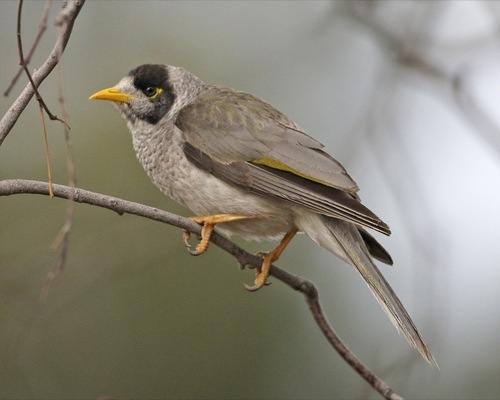


Noisy Miner
manorina melanocephala
Meet the Noisy Miner (Manorina melanocephala), a true character of the Australian bush and increasingly, its urban fringes. This lively honeyeater is impossible to ignore, not just for its striking appearance but for its constant, boisterous vocalizations and highly social, yet fiercely territorial, nature. Noisy Miners form large, complex colonies where individuals work together to defend their patch from intruders, often mobbing much larger birds. Their adaptability has allowed them to thrive in human-modified landscapes, making them a common sight and sound across eastern Australia. Observing their intricate social dynamics and communal life offers a fascinating glimpse into avian intelligence and cooperation, even as their success can sometimes impact smaller native bird populations.
Habitat: The Noisy Miner is typically found in open eucalypt woodlands, forests, and often urban parks and gardens, particularly where undergrowth is sparse.
The Noisy Miner is a medium-sized honeyeater, typically measuring 24-28 cm in length. It has a predominantly grey body with a striking black head, nape, and throat. A prominent patch of bare yellow skin behind the eye, combined with a bright yellow bill and legs, provides distinct identification marks. Its wings feature a subtle yellow patch, and its tail is grey with faint yellow edges. The overall impression is a sleek, robust bird with bold, contrasting colors.
Category
BirdsRarity
Common
Danger
1/5 · Very low
Snaps
Be the first to snap!
Despite their name, Noisy Miners are honeyeaters, not true miners, and feed primarily on nectar and insects, often gleaning them from eucalypt leaves.
Noisy Miners are known to form 'camps' or 'colonies' that can consist of hundreds of individuals, communicating through a complex array of vocalizations.
Their aggressive territorial behavior, particularly towards smaller bird species, has been linked to the decline of small insectivorous birds in fragmented urban and rural landscapes, a phenomenon known as 'Noisy Miner effect.'
They engage in allopreening, where individuals preen each other, reinforcing social bonds within their colonial groups.
Noisy Miners are highly territorial and will vigorously mob potential threats, including larger birds of prey, snakes, and even humans, working cooperatively in groups to drive intruders away.
They possess a diverse repertoire of calls, from loud, distinctive 'pwee' notes to alarm calls and softer contact calls, used for communication within their large colonies and territorial defense.
Noisy Miners live in large colonies where multiple adults, including non-breeding individuals, assist in feeding and defending the young of a few breeding pairs, enhancing breeding success.
Noisy Miners are opportunistic omnivores, primarily feeding on nectar, insects, and other invertebrates, but also consuming fruits, seeds, and occasionally small vertebrates.
Ptilotula penicillata
Noisy Miners aggressively exclude smaller honeyeaters from their territories, impacting their access to resources.
Eucalyptus spp.
Noisy Miners often target insects found on eucalyptus trees, making them a significant part of the tree's insect control.
Gymnorhina tibicen
Predation risk for Noisy Miner eggs and chicks, especially by opportunistic avian predators.
Cacomantis pallidus
Young Noisy Miners are sometimes parasitized by cuckoos, which lay their eggs in the miner's nest.
No trait badges are assigned for this object yet.
No aliases listed yet.
Collections for this object will appear here as more themes are added.
Danger
1/5 · Very low
No special safety notes yet.
Compare the silhouette, bill shape, tail length, wing bars and markings around the eyes. The same small brown bird at your feeder can look quite different in breeding plumage, winter plumage or its first year. Bird Identifier: upload a photo and compare the visible details.
24-28 cm
35-45 cm
0.06-0.08 kg
6-10 years
Noisy Miners are opportunistic omnivores, primarily feeding on nectar, insects, and other invertebrates, but also consuming fruits, seeds, and occasionally small vertebrates.
The Noisy Miner is typically found in open eucalypt woodlands, forests, and often urban parks and gardens, particularly where undergrowth is sparse.
Foraging
Zoom in to split clusters and explore where this object has been snapped.
Recent snaps will appear here as new observations are added.
Take the discovery with you
Snap it with Snappit to identify it, learn what makes it special, and add the discovery to your collection.