

Noni
morinda citrifolia
Noni, scientifically known as Morinda citrifolia, is an evergreen shrub or small tree belonging to the coffee family. Celebrated for its remarkable resilience and ecological value, it is widely recognized for its distinctive, bumpy, potato-sized fruit. Known historically as a vital 'canoe plant' transported across the Pacific by Polynesian voyagers, Noni has been prized for centuries in traditional medicine, dyes, and emergency food supplies. Today, it remains a fascinating subject of study for its ability to thrive in harsh coastal environments and volcanic soils.
Habitat: Typically found in tropical coastal regions, volcanic plains, forest understories, and disturbed lands.
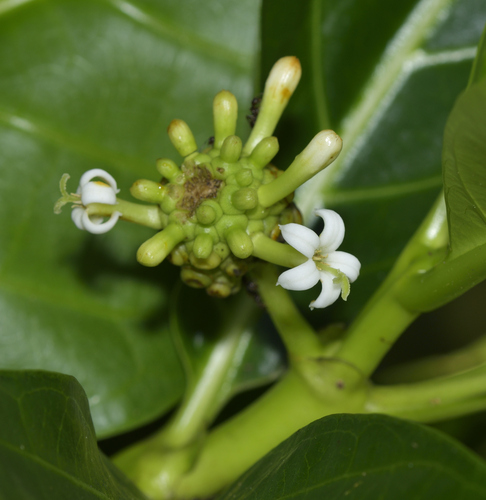
Noni is a small tree reaching 3 to 9 meters in height, featuring large, glossy green leaves with deeply indented veins. Its most recognizable feature is the compound fruit, which is oval, bumpy, and warty. The fruit transitions from green to a pale, translucent yellow or white as it ripens. When ripe, it releases a highly distinctive, strong odor reminiscent of rancid cheese. Small, white, tubular flowers sprout directly from the fruiting head during its multi-stage growth process.
Category
PlantsRarity
Common
Danger
1/5 · Very low
Snaps
4
It is colloquially known as 'vomit fruit' or 'cheese fruit' due to the strong, pungent smell of butyric acid in its ripe fruit.
Noni is one of the few pioneer plants capable of colonizing harsh, freshly cooled volcanic lava flows.
Polynesian pioneers carried Noni in their voyaging canoes as a core 'canoe plant' because of its versatile medicinal applications.
Noni can thrive in soils with exceptionally high salinity and can survive occasional inundation by seawater, making it a highly successful coastal colonizer.
It produces flowers and fruits year-round simultaneously on the same branch, ensuring a steady food source for local fauna and constant seed dispersal.
As the fruit ripens, it accumulates high levels of butyric and octanoic acids, emitting a pungent smell that deters most herbivores while attracting specialized seed dispersers.
As a photosynthetic plant, Noni synthesizes its own energy from sunlight, carbon dioxide, and water while absorbing essential nutrients from the soil.
Drosophila sechellia
Feeds on the fermented fruit juices of ripe noni, having evolved a unique tolerance to the toxins that are lethal to other Drosophila species.
Pteropus tonganus
Consumes the pungent fruits and aids in seed dispersal across islands.
Oecophylla smaragdina
Builds nests in the large leaves and provides protection against herbivorous insects.
No trait badges are assigned for this object yet.
No aliases listed yet.
Collections for this object will appear here as more themes are added.
Danger
1/5 · Very low
No special safety notes yet.
Start with the whole plant, then compare leaf arrangement, leaf edges, stems and any flowers or fruit. Opposite leaves grow in pairs; alternate leaves come one at a time along the stem. These details tell you far more together than a single green leaf does. Plant Identifier: upload a photo and compare the visible details.
300-900 cm
20-50 years
As a photosynthetic plant, Noni synthesizes its own energy from sunlight, carbon dioxide, and water while absorbing essential nutrients from the soil.
Typically found in tropical coastal regions, volcanic plains, forest understories, and disturbed lands.
30-90 days
Zoom in to split clusters and explore where this object has been snapped.
Take the discovery with you
Snap it with Snappit to identify it, learn what makes it special, and add the discovery to your collection.