
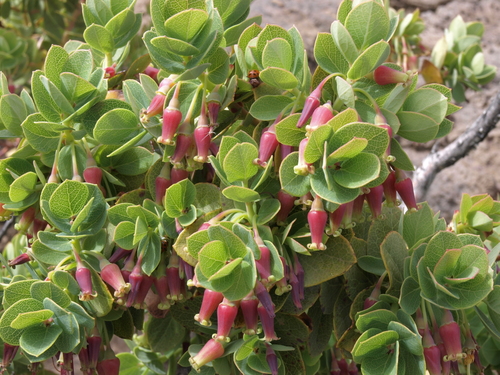


'Ohelo 'Ai
vaccinium reticulatum
The 'Ohelo 'Ai (Vaccinium reticulatum) is a resilient, endemic Hawaiian shrub that thrives in some of the most barren volcanic landscapes on the islands of Maui and Hawaii. Growing low to the ground, this member of the heather family is famous for its colorful, edible berries that range from bright red to yellow and orange. It plays a vital role in local Hawaiian culture and ecology, serving as a pioneer species on fresh lava flows. Historically, this plant is deeply intertwined with Hawaiian mythology, particularly as a sacred offering to Pele, the volcano goddess. Its hardy nature allows it to withstand extreme sun, wind, and nutrient-poor volcanic ash, making it one of the first plants to establish life in newly created lands. Visitors to high-elevation areas like Haleakala and Hawaii Volcanoes National Park frequently encounter this beautiful and culturally significant plant.
Habitat: Found in high-elevation volcanic shrublands, alpine deserts, and open bogs, typically on relatively recent lava flows and ash fields.
This compact, woody shrub typically stands between 10 to 130 centimeters tall, often taking a rounded or prostrate form to shield itself from high-altitude winds. Its small, stiff, rounded leaves are leathery with finely serrated edges, often starting out as a vibrant reddish-pink when young before maturing to dark green. The flowers are small, bell-shaped, and hang downwards, colored in hues of pink, red, or greenish-yellow. The most striking feature is its clusters of fleshy, spherical berries, which showcase brilliant shades of red, yellow, or orange and are dusted with a light, waxy bloom.
Category
PlantsRarity
Common
Danger
1/5 · Very low
Snaps
Be the first to snap!
In Hawaiian tradition, the berries are sacred to Pele, the goddess of volcanoes, and custom requires offering a branch to her before eating any.
Its species name 'reticulatum' refers to the distinct, net-like pattern of veins visible on its stiff, leathery leaves.
The berries are a primary food source for the Nene, Hawaii's native and endangered state bird.
It is exceptionally adapted to colonizing harsh, nutrient-poor volcanic ash and recent lava flows where other plants cannot survive.
It associates with specialized ericoid mycorrhizal fungi in the soil to maximize nutrient and water uptake in barren volcanic environments.
Its thick, leathery leaves and low stature protect it from intense solar radiation, heavy winds, and freezing alpine temperatures.
As a photoautotrophic plant, it synthesizes its own energy from sunlight, carbon dioxide, and water using chlorophyll.
Branta sandvicensis
The endangered Hawaiian goose feeds heavily on the nutritious berries and acts as the primary seed disperser.
Drepanis coccinea
Nectar-feeding Hawaiian honeycreepers visit the bell-shaped flowers, pollinating them in the process.
No trait badges are assigned for this object yet.
No aliases listed yet.
Collections for this object will appear here as more themes are added.
Danger
1/5 · Very low
No special safety notes yet.
Start with the whole plant, then compare leaf arrangement, leaf edges, stems and any flowers or fruit. Opposite leaves grow in pairs; alternate leaves come one at a time along the stem. These details tell you far more together than a single green leaf does. Plant Identifier: upload a photo and compare the visible details.
10-150 cm
10-50 years
As a photoautotrophic plant, it synthesizes its own energy from sunlight, carbon dioxide, and water using chlorophyll.
Found in high-elevation volcanic shrublands, alpine deserts, and open bogs, typically on relatively recent lava flows and ash fields.
Zoom in to split clusters and explore where this object has been snapped.
Recent snaps will appear here as new observations are added.
Take the discovery with you
Snap it with Snappit to identify it, learn what makes it special, and add the discovery to your collection.


















