





Oleander seedbug
Caenocoris nerii
The Oleander seedbug is a small, colorful insect that loves to munch on oleander plants. They have a unique shape and can be found resting on leaves, making them fun to spot in gardens.
Habitat: Urban areas
The Oleander seedbug has a striking elongated oval body, boldly patterned in bright red and black. It features two prominent black spots on its pronotum and corium, contrasting sharply with its red background. Its head, antennae, and legs are also black, making it visually distinct.
Category
InsectsRarity
Common
Danger
1/5 · Very low
Snaps
Be the first to snap!
Baby seedbugs, called nymphs, look just like tiny adults, but without wings yet!
Their bright red and black colors are like a 'danger!' sign to hungry birds.
These bugs gather in huge groups, sometimes covering entire plants!
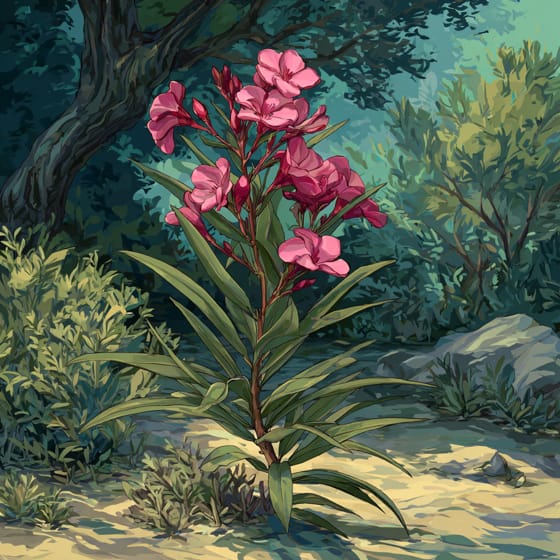
They eat deadly oleander plants, but the toxins just make *them* poisonous too!
Oleander seedbugs have a unique ability to safely consume toxic oleander plants, because of special adaptations that allow them to process the plant's poisons.
Oleander seedbugs have vibrant red and black patterns that act as a visual warning to predators, because these colors signal their unpalatability.
Oleander seedbugs have specialized piercing-sucking mouthparts that help them extract nourishing sap and vital fluids from plant tissues.
They sip the juicy sap and seeds from oleander plants.
Solitary animals live alone for most of their lives, only interacting with others for mating or parental care.
Colorful describes organisms or objects displaying a wide range of bright and distinct colors.
This trait characterizes organisms whose diet consists entirely or primarily of plant material.
Diurnal animals are primarily active during daylight hours, typically resting or sleeping at night.

This habitat trait indicates species that can coexist with humans in urban and suburban environments, utilizing man-made structures and green spaces.

Describes organisms that transfer pollen, enabling the fertilization and reproduction of plants.
No aliases listed yet.
Danger
1/5 · Very low
It's best to watch these bugs from a distance and not touch them.
The easiest way to identify Oleander seedbug is to use the Snappit nature identifier app.
10-18 mm
6-11 mm
30-90 days
They sip the juicy sap and seeds from oleander plants.
Urban areas
Foraging
6
Zoom in to split clusters and explore where this object has been snapped.
Recent snaps will appear here as new observations are added.
Take the discovery with you
Snap it with Snappit to identify it, learn what makes it special, and add the discovery to your collection.







.jpg&width=800)



