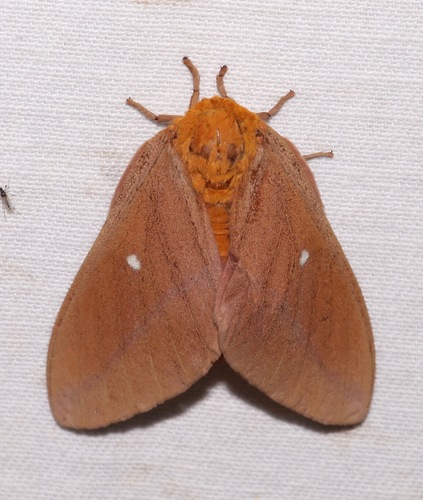


Oslar'S Oakworm Moth
anisota oslari
Oslar's Oakworm Moth is a captivating member of the wild silk moth family, native to the rugged oak woodlands of the southwestern United States and Mexico. As caterpillars, they are voracious consumers of oak foliage, sporting striking patterns that serve to deter predators. Upon reaching adulthood, these moths undergo a dramatic transformation, emerging as beautifully colored moths with vestigial mouthparts, meaning their sole focus during their brief adult lives is reproduction.
Habitat: Typically found in arid oak woodlands, canyons, and foothill scrublands where their primary oak host plants are abundant.
Adults exhibit a warm palette of yellow-orange to reddish-brown coloration, with females being significantly larger and more robust than the males. The forewings feature a distinctive, small white discal spot near the center and are often flecked with fine dark purplish-brown speckles, while a thin, dark line runs diagonally across the wing. Males possess feathery antennae used to detect female pheromones and are typically darker and more active during daylight hours.
Category
InsectsRarity
Common
Danger
1/5 · Very low
Snaps
Be the first to snap!
Adult Oslar's Oakworm Moths live for only about a week, as they lack functional digestive systems and cannot eat.
Males of this species are day-fliers, which is unusual for Saturniid moths, and they fly with a rapid, zig-zagging pattern to find females.
The caterpillars of this species are gregarious in their early stages, feeding in large, synchronized groups on oak leaves.
Females release powerful chemical attractants that males can detect from miles away using their specialized feathered antennae.
Adults possess no functioning mouthparts and do not feed, relying entirely on energy reserves stored during their larval stage.
The caterpillars feature sharp spikes and bright warning colors to deter birds and other insect-eating predators.
Caterpillars feed exclusively on the leaves of oak trees, while adult moths do not feed at all due to vestigial mouthparts.
Age differences: Larvae feed continuously on oak foliage, while adults do not consume any food and live only a few days to reproduce.
Quercus arizonica
The primary food plant for the caterpillars of Anisota oslari.
Aphelocoma wollweberi
Predator of the larval and adult stages in southwestern oak forests.
No trait badges are assigned for this object yet.
No aliases listed yet.
Collections for this object will appear here as more themes are added.
Danger
1/5 · Very low
No special safety notes yet.
Compare resting wing shape, forewing markings, antennae and body build. Small brown moths can hinge on fine details a phone photo can't always catch. Moth Identifier: upload a photo and compare the visible details.
2-4 cm
4-9 cm
0.001-0.003 kg
0-1 years
15 km/h
Caterpillars feed exclusively on the leaves of oak trees, while adult moths do not feed at all due to vestigial mouthparts.
Typically found in arid oak woodlands, canyons, and foothill scrublands where their primary oak host plants are abundant.
Zoom in to split clusters and explore where this object has been snapped.
Recent snaps will appear here as new observations are added.
Take the discovery with you
Snap it with Snappit to identify it, learn what makes it special, and add the discovery to your collection.