

Parry Clover
trifolium parryi
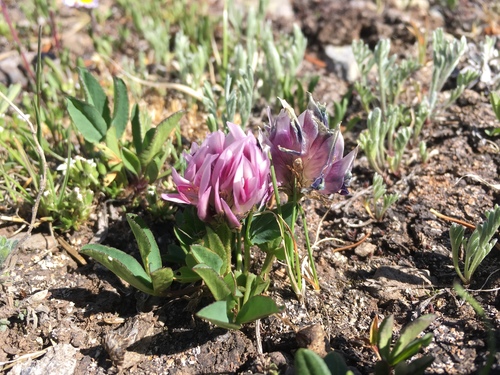
Parry Clover (Trifolium parryi) is a beautiful alpine perennial wildflower native to the high-altitude regions of western North America, particularly the Rocky Mountains. Named after the famed 19th-century botanist Charles Christopher Parry, this resilient clover thrives in harsh tundra environments where few other plants can survive. It forms low-growing mats or tufts, providing vibrant splashes of color to rocky slopes, meadows, and alpine basins. Beyond its aesthetic appeal, Parry Clover plays a crucial ecological role. Like other members of the legume family, it possesses the remarkable ability to fix atmospheric nitrogen, enriching the nutrient-poor alpine soils for neighboring plant species. It also serves as an important food source for native pollinators and alpine wildlife, making it a cornerstone of high-mountain ecosystems.
Habitat: Typically found in moist alpine and subalpine meadows, rocky ridges, and tundra slopes at high elevations.
This low-growing perennial herb features hairless, trifoliate leaves composed of three oval leaflets with finely toothed margins. The striking, globe-like flower heads are made up of 10 to 40 individual pea-like flowers, which range in color from a deep rose-purple to pinkish-red. Each flower head is supported by a leafless stem that rises slightly above the foliage, reaching heights of 5 to 20 centimeters. The basal leaves form a neat, dense clump that clings close to the ground, an adaptation that helps the plant withstand strong alpine winds.
Category
PlantsRarity
Common
Danger
1/5 · Very low
Snaps
Be the first to snap!
Because it fixes nitrogen, it acts as a natural fertilizer, helping surrounding alpine plants colonize harsh, newly exposed rocky soils.
Its compact, low-growing form is a survival strategy called a 'cushion habit', which creates a warmer microclimate inside the plant than the freezing ambient air.
Parry Clover is named after Charles Christopher Parry, a prominent 19th-century botanist who collected thousands of western North American plant specimens.
Partners with symbiotic rhizobia bacteria in its root nodules to convert atmospheric nitrogen into a usable nutrient form.
Produces specialized cellular solutes and low-growing, compact mats that protect vital tissues from freezing alpine temperatures.
Possesses thick, waxy leaf surfaces that help reduce water loss in dry, windy, and high-UV alpine environments.
As a photosynthetic plant, Parry Clover generates its own energy from sunlight, carbon dioxide, and water, supplemented by nitrogen fixed from the soil.
Bombus bifarius
Pollinated by bumble bees seeking nectar.

Ovis canadensis
Provides essential forage for alpine mammals during the short summer growing season.
Rhizobium leguminosarum
Hosts symbiotic nitrogen-fixing bacteria in its root system.
No trait badges are assigned for this object yet.
No aliases listed yet.
Collections for this object will appear here as more themes are added.
Danger
1/5 · Very low
No special safety notes yet.
Start with the whole plant, then compare leaf arrangement, leaf edges, stems and any flowers or fruit. Opposite leaves grow in pairs; alternate leaves come one at a time along the stem. These details tell you far more together than a single green leaf does. Plant Identifier: upload a photo and compare the visible details.
5-20 cm
3-10 years
As a photosynthetic plant, Parry Clover generates its own energy from sunlight, carbon dioxide, and water, supplemented by nitrogen fixed from the soil.
Typically found in moist alpine and subalpine meadows, rocky ridges, and tundra slopes at high elevations.
Photosynthesis
Zoom in to split clusters and explore where this object has been snapped.
Recent snaps will appear here as new observations are added.
Take the discovery with you
Snap it with Snappit to identify it, learn what makes it special, and add the discovery to your collection.