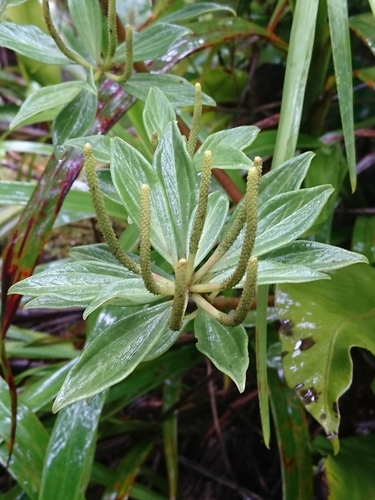


Peperomia Hesperomannii
peperomia hesperomannii
Peperomia hesperomannii is a rare, charming succulent herb endemic to the wet, mossy forests of Kauai, Hawaii. Locally known as 'ala'ala wai nui, this shade-loving perennial thrives in the humid understory, clinging to damp rocks or moss-covered tree trunks. Its fleshy, dark green leaves and slender, light green flower spikes are classic features of the Piperaceae family. This delicate species plays an important role in its fragile island ecosystem, providing microhabitats for native invertebrates and participating in complex forest food webs.
Habitat: Found in humid Hawaiian montane forests, typically growing as an epiphyte on mossy tree trunks or as a lithophyte on damp rocks.
This compact herb typically reaches 10 to 30 cm in height, featuring upright or sprawling succulent stems. Its leaves are oppositely arranged or clustered in whorls, presenting an elongated, elliptic to lanceolate shape with a smooth, glossy surface and a rich forest-green hue. The plant produces tiny, inconspicuous green flowers tightly packed along narrow, spike-like inflorescences (spadices) that rise above the foliage, presenting a distinctive, velvety texture.
Category
PlantsRarity
Common
Danger
1/5 · Very low
Snaps
Be the first to snap!
Its seeds are covered in a sticky substance that works like natural Velcro, hitchhiking on native forest birds to colonize new mossy branches.
The Hawaiian name for Peperomia is 'ala'ala wai nui, which poetically refers to its succulent, water-retaining nature.
Unlike many common houseplants in the Peperomia genus, Peperomia hesperomannii is extremely sensitive and is rarely found outside its native pristine Hawaiian rainforest habitat.
Produces extremely sticky seeds that easily adhere to the feathers of native forest birds, facilitating efficient seed dispersal.
Fleshy leaves and stems store water, allowing the plant to survive temporary dry spells in its high-elevation epiphytic perches.
Specially adapted to thrive in the deeply shaded forest understory, maximizing minimal sunlight penetration through the canopy.
As a photosynthetic plant, it synthesizes its own food using sunlight, water, and carbon dioxide, supplemented by nutrients absorbed from surrounding organic debris.
Chlorodrepanis stejnegeri
Disperses the sticky seeds of the plant via epizoochory when the bird brushes against the mature seed spikes.
Succinea caduca
Occasionally grazes on the fleshy leaves and associated micro-fungi growing on damp Peperomia stems.
No trait badges are assigned for this object yet.
No aliases listed yet.
Collections for this object will appear here as more themes are added.
Danger
1/5 · Very low
No special safety notes yet.
Start with the whole plant, then compare leaf arrangement, leaf edges, stems and any flowers or fruit. Opposite leaves grow in pairs; alternate leaves come one at a time along the stem. These details tell you far more together than a single green leaf does. Plant Identifier: upload a photo and compare the visible details.
10-30 cm
0.05-0.25 kg
3-10 years
As a photosynthetic plant, it synthesizes its own food using sunlight, water, and carbon dioxide, supplemented by nutrients absorbed from surrounding organic debris.
Found in humid Hawaiian montane forests, typically growing as an epiphyte on mossy tree trunks or as a lithophyte on damp rocks.
Zoom in to split clusters and explore where this object has been snapped.
Recent snaps will appear here as new observations are added.
Take the discovery with you
Snap it with Snappit to identify it, learn what makes it special, and add the discovery to your collection.