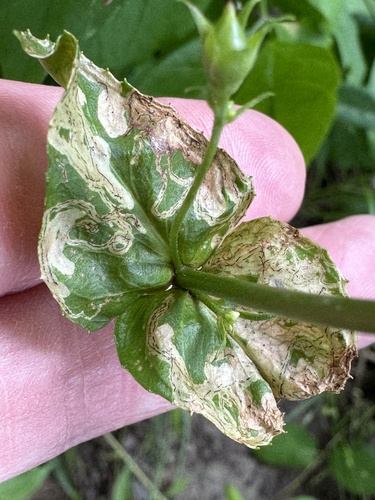





Phytomyza penstemonis
Phytomyza penstemonis
Phytomyza penstemonis is a tiny fly that loves to munch on the leaves of penstemon plants. These little insects are important for nature, helping to keep the balance in gardens and wild areas.
Habitat: Gardens and wildflower areas
The Phytomyza penstemonis is a tiny, dark-bodied fly, typically black or grayish-brown, with clear, iridescent wings that have noticeable vein patterns. It has large, reddish-brown compound eyes that stand out against its small head, making it visually distinct from many other small, uniformly dark flies.
Category
InsectsRarity
Common
Danger
1/5 · Very low
Snaps
Be the first to snap!
Adult Penstemon leaf miners are so tiny, many could fit on the head of a pin.
Female flies create tiny holes in leaves to taste if a plant is right for their eggs.
The larva actually moves its whole body to chew, making its long tunnel even wider.
Their larval tunnels are called 'mines' and look like squiggly, pale maps inside the leaves!
Phytomyza penstemonis can tunnel through plant leaves because its larvae have specialized mouthparts that help them eat and create intricate tunnels.
Phytomyza penstemonis has an amazing sense of smell that helps it locate specific Penstemon plants to lay its eggs on.
Phytomyza penstemonis can complete its entire life cycle in just a few weeks, which helps it have many generations per year.
Young larvae feast on plant leaves, while adult flies sip on plant nectar and sap.
Age differences: Larvae consume plant leaf tissue, while adults feed on plant nectar and sap.

Penstemon digitalis
Larvae mine the leaves of this host plant.
Diglyphus isaea
Larvae are parasitized by this tiny wasp species.

Poecile atricapillus
Small birds may prey on adult flies.
Solitary animals live alone for most of their lives, only interacting with others for mating or parental care.
This trait characterizes organisms whose diet consists entirely or primarily of plant material.
Diurnal animals are primarily active during daylight hours, typically resting or sleeping at night.
Describes a species whose presence and role have a disproportionately large effect on its environment.
Pertaining to species that are significantly smaller than typical or average for their kind.
Describes organisms that transfer pollen, enabling the fertilization and reproduction of plants.
No aliases listed yet.
Danger
1/5 · Very low
These flies are harmless, but it's best to leave them alone to do their job!
Look for six legs, antennae, three body sections and the shape of the wings. Beetles have hardened front wings; flies have just one working pair. Tiny insects may need a close view before their group is clear. Insect Identifier: upload a photo and compare the visible details.
2-5 mm
1-3 mm
20-40 days
Young larvae feast on plant leaves, while adult flies sip on plant nectar and sap.
Gardens and wildflower areas
Foraging
6
Zoom in to split clusters and explore where this object has been snapped.
Recent snaps will appear here as new observations are added.
Take the discovery with you
Snap it with Snappit to identify it, learn what makes it special, and add the discovery to your collection.