





Foxglove Beardtongue
penstemon digitalis
The Foxglove Beardtongue is a beautiful flowering plant that attracts bees and butterflies with its colorful blooms. It grows tall and has soft, fuzzy leaves that feel nice to touch!
Habitat: Foxglove Beardtongue typically grows in open woodlands, meadows, and along roadsides.
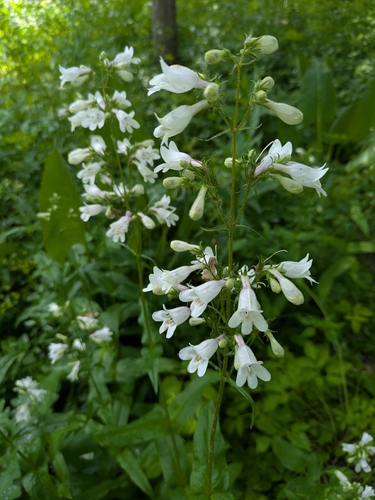
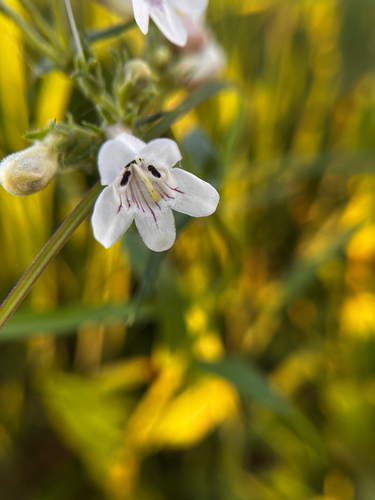
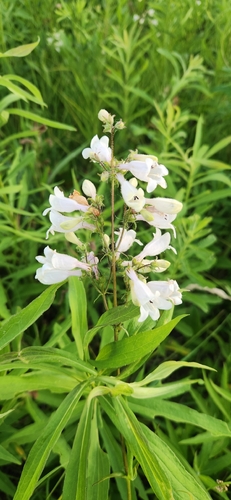
The Foxglove Beardtongue has tall, upright stems topped with clusters of bell-shaped, white to pale pink or lavender flowers. Its tubular blossoms feature two lips and often a fuzzy lower "beard," visually distinguishing them from true foxgloves.
Category
PlantsRarity
Common
Danger
0/5 · No known danger
Snaps
51
Despite its name, it's not a true foxglove, but a clever look-alike!
Its "beard" is a sterile stamen, acting like a fuzzy guide for pollinating bees!
Its seeds can hide for years, then sprout when conditions are right!
These tough plants can survive harsh winters and bounce back year after year!
Its lower lip acts as a landing strip for long-tongued bees, guiding them to nectar for efficient pollination.
Its fuzzy 'beard' helps keep out tiny ants that might steal nectar without pollinating the flower.
Apis mellifera
Visits flowers for nectar and pollen

Bombus impatiens
Gathers nectar and pollen from tubular blossoms
Schinia arcigera
Larvae feed on its seeds and flowers
Perennial plants live for more than two years, typically returning to grow and bloom each year from their roots.
Herbaceous plants are non-woody plants with soft stems that typically die back to the ground at the end of the growing season.
Colorful describes organisms or objects displaying a wide range of bright and distinct colors.
Describes organisms that transfer pollen, enabling the fertilization and reproduction of plants.
Danger
0/5 · No known danger
No special safety notes yet.
The easiest way to identify Foxglove Beardtongue is to use the Snappit nature identifier app.
60-120 cm
30-60 cm
2-3 cm
Late spring to early summer
No
None
Perennial
Zoom in to split clusters and explore where this object has been snapped.
Jun 6, 2026
West Argyle Street Historic DistrictPhoto attribution
(c) Jeremy Atherton, some rights reserved (CC BY)
License: CC BY 4.0 ↗
Image may be shown cropped inside the card frame.
Jun 6, 2026
Bascom HillPhoto attribution
(c) Mason Holum, some rights reserved (CC BY)
License: CC BY 4.0 ↗
Image may be shown cropped inside the card frame.
Jun 4, 2026
Busse WoodsPhoto attribution
(c) Chris, some rights reserved (CC BY-SA)
License: CC BY-SA 4.0 ↗
Image may be shown cropped inside the card frame.

New York, US
You might spot Sundial Lupine, Spotted Horsemint, and New Jersey Tea.
View guide →

Pennsylvania, US
You might spot American Robin, Red-Winged Blackbird, and Lesser Celandine.
View guide →

Wisconsin, US
You might spot Turkey, White-Tailed Deer, and Dame's Rocket.
View guide →

Rhode Island, US
You might spot Tundra Bean Goose, Tansy, and Osprey.
View guide →

Illinois, US
You might spot American Robin, Monarch, and Duck.
View guide →
Ohio, US
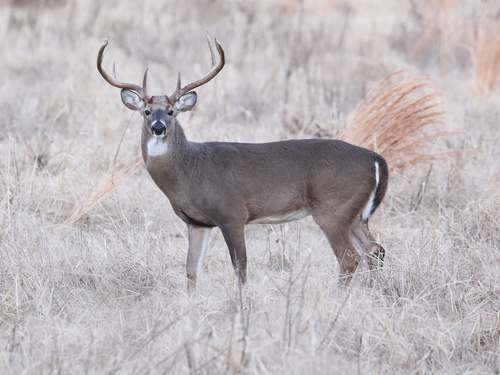
You might spot White-Tailed Deer, Mayapple, and American Beech.
View guide →
Take the discovery with you
Snap it with Snappit to identify it, learn what makes it special, and add the discovery to your collection.









.jpg&width=800)



_001.jpg&width=800)




