

Pink Candytuft
iberis carnosa
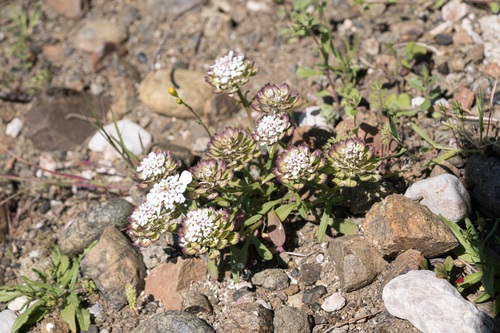
Pink Candytuft (Iberis carnosa) is a delightful, low-growing perennial plant that belongs to the mustard family, Brassicaceae. Originating from the rocky mountainous regions of Southern Europe, this resilient subshrub is renowned for its ability to thrive in harsh, limestone-rich soils where few other plants can survive. It forms tight, evergreen cushions of fleshy leaves that burst into a spectacular blanket of pale pink, mauve, or white blossoms in late spring and early summer. Its hardy nature and beautiful, fragrant clusters make it a highly prized addition to rock gardens and alpine displays. Beyond its aesthetic charm, Pink Candytuft plays an important ecological role by providing early-season nectar to a variety of wild pollinators, including bees and butterflies, making it a lively hub of biodiversity in rocky alpine environments.
Habitat: Found in rocky limestone screes, gravelly alpine slopes, and mountain cliffs across Southern Europe.
Pink Candytuft is a small, cushion-forming perennial subshrub typically reaching 5 to 15 centimeters in height. It features small, spatulate, fleshy green leaves that are slightly succulent to the touch. The flowers are arranged in dense, flat-topped clusters of pale pink, lavender, or white. Each individual flower has four petals, with the two outer petals significantly larger than the inner two, creating an asymmetrical, frilly appearance characteristic of the genus. Its seed pods are small, winged, and round.
Category
PlantsRarity
Common
Danger
1/5 · Very low
Snaps
Be the first to snap!
Despite the sweet-sounding name, 'candytuft' is actually derived from 'Candia', the old English name for the island of Crete, from which the first seeds were imported.
The genus name 'Iberis' is derived from Iberia, the ancient name for Spain, where a high diversity of candytuft species can be found.
Their distinctive lopsided flowers serve as landing pads designed perfectly for bees and butterflies.
Exhibits extreme tolerance for alkaline, calcium-rich rocky soils where most other plants struggle to absorb nutrients.
Features fleshy, thickened leaves that store water efficiently, allowing it to survive prolonged dry spells on exposed rock faces.
Produces larger outer petals that mimic a larger single blossom, more effectively guiding pollinators to the tiny center of the flower cluster.
As a photoautotrophic plant, it produces its own energy through photosynthesis using sunlight, water, carbon dioxide, and minerals from the soil.
Apis mellifera
Provides critical nectar and pollen to early emerging honey bees in high-altitude regions.
Pieris brassicae
The leaves and stems are occasionally consumed by the larvae of white butterflies.
No trait badges are assigned for this object yet.
No aliases listed yet.
Collections for this object will appear here as more themes are added.
Danger
1/5 · Very low
No special safety notes yet.
Start with the whole plant, then compare leaf arrangement, leaf edges, stems and any flowers or fruit. Opposite leaves grow in pairs; alternate leaves come one at a time along the stem. These details tell you far more together than a single green leaf does. Plant Identifier: upload a photo and compare the visible details.
5-15 cm
0.01-0.05 kg
3-10 years
As a photoautotrophic plant, it produces its own energy through photosynthesis using sunlight, water, carbon dioxide, and minerals from the soil.
Found in rocky limestone screes, gravelly alpine slopes, and mountain cliffs across Southern Europe.
Zoom in to split clusters and explore where this object has been snapped.
Recent snaps will appear here as new observations are added.
Take the discovery with you
Snap it with Snappit to identify it, learn what makes it special, and add the discovery to your collection.