


Pua Kala
argemone glauca
Pua Kala (Argemone glauca), also known as the Hawaiian poppy, is a striking endemic plant species native to the Hawaiian Islands. This hardy perennial is renowned for its brilliant white blossoms contrasted against a center of numerous bright yellow stamens. Thriving in the harsh, arid environments of coastal dunes, dry shrublands, and volcanic slopes, it stands out as one of the few native Hawaiian plants equipped with sharp defensive spines. Historically, Pua Kala held significant cultural and medicinal value for Native Hawaiians, who utilized its bright yellow, latex-like sap to relieve toothaches and skin ailments. Today, it serves as a vital component of Hawaii's fragile dryland ecosystems, providing nourishment for native pollinators and acting as a pioneer species on dry volcanic terrains.
Habitat: Typically found on dry, rocky, and sun-exposed slopes, lava fields, and coastal shrublands across the Hawaiian Islands.
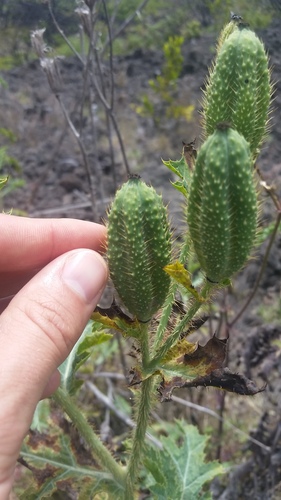
This erect, bushy herb typically reaches heights between 60 to 120 cm. It is easily identified by its spectacular, large white flowers with crepe-paper-like petals measuring up to 8 cm across, surrounding a dense central cluster of golden-yellow stamens. Its foliage is deeply lobed, pale bluish-green (glaucous), and heavily armed with sharp, stiff spines along the leaf margins and stems. After flowering, it produces oblong, spiny seed pods that split open to release numerous small black seeds.
Category
PlantsRarity
Common
Danger
1/5 · Very low
Snaps
Be the first to snap!
Ancient Hawaiians used the bright yellow latex sap of the plant as an analgesic to treat painful toothaches and neuralgias.
Its scientific name, Argemone glauca, refers to its glaucescent or bluish-green waxy leaves that help it survive intense Hawaiian sunlight.
Pua Kala is one of the very few native Hawaiian plants that evolved physical defenses like thorns, which is unusual since Hawaii historically lacked native mammalian herbivores.
Produces a powdery, waxy coating on its leaves that gives them a bluish hue and helps reduce water loss in arid conditions.
Deters potential herbivores with sharp, formidable spines that densely cover its stems, leaves, and seed pods.
Develops a deep, robust taproot system to secure moisture and stabilize itself in loose volcanic soils.
As a photoautotrophic plant, Pua Kala generates its own food using sunlight, carbon dioxide, water, and minerals through the process of photosynthesis.
Hylaeus anthracinus
The endemic Hawaiian yellow-faced bee collects pollen from the large yellow centers of Pua Kala flowers.
Xylocopa sonorina
The introduced Sonoran carpenter bee visits the flowers for nectar and acts as an effective pollinator.
No trait badges are assigned for this object yet.
No aliases listed yet.
Collections for this object will appear here as more themes are added.
Danger
1/5 · Very low
No special safety notes yet.
Start with the whole plant, then compare leaf arrangement, leaf edges, stems and any flowers or fruit. Opposite leaves grow in pairs; alternate leaves come one at a time along the stem. These details tell you far more together than a single green leaf does. Plant Identifier: upload a photo and compare the visible details.
60-120 cm
2-5 years
As a photoautotrophic plant, Pua Kala generates its own food using sunlight, carbon dioxide, water, and minerals through the process of photosynthesis.
Typically found on dry, rocky, and sun-exposed slopes, lava fields, and coastal shrublands across the Hawaiian Islands.
50-150
14-28 days
Zoom in to split clusters and explore where this object has been snapped.
Recent snaps will appear here as new observations are added.
Take the discovery with you
Snap it with Snappit to identify it, learn what makes it special, and add the discovery to your collection.


















