
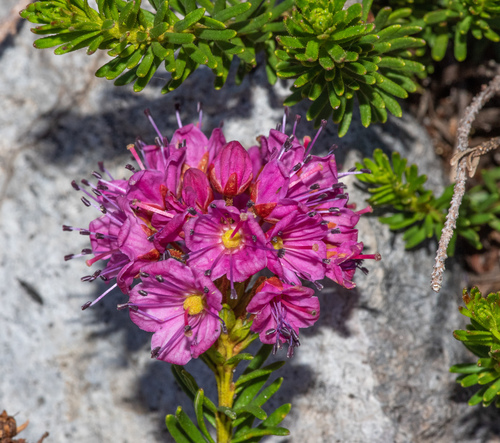


Purple Mountain-Heath
phyllodoce breweri
The Purple Mountain-Heath (Phyllodoce breweri) is a stunning, low-growing evergreen shrub native to the high-elevation regions of California, particularly the Sierra Nevada and Klamath Mountains. Thriving in the harsh, wind-swept environments of subalpine meadows and rocky talus slopes, this resilient plant brings vibrant life to alpine landscapes each summer. When in bloom, it forms dense, colorful mats of bright rosy-purple flowers that paint the mountain slopes with spectacular hues. It is highly valued by hikers, botanists, and nature enthusiasts for its hardy nature and the delicate beauty it adds to rugged terrains. As a member of the heath family (Ericaceae), it is closely related to rhododendrons and blueberries, sharing their preference for acidic, well-drained soils.
Habitat: Found in high-elevation subalpine meadows, rocky slopes, and moist coniferous forests of the Sierra Nevada.
This low-growing shrub stands between 10 and 40 centimeters tall, featuring dense, rigid branches covered in small, needle-like, evergreen leaves with rolled edges. The most striking feature is its cup- or bowl-shaped, bright pinkish-purple flowers, which bloom in terminal clusters. Uniquely, the flowers have exceptionally long, protruding stamens that extend well past the petals, giving the blossoms a distinctively fuzzy appearance.
Category
PlantsRarity
Common
Danger
1/5 · Very low
Snaps
Be the first to snap!
Its leaves resemble miniature pine needles, which is an evolutionary trait developed to limit water loss in windy, dry high-altitude environments.
Named after William Henry Brewer, a prominent 19th-century American botanist who worked on the California Geological Survey.
The flowers have exceptionally long, protruding stamens (male reproductive parts) that extend far beyond the petals, giving them a fuzzy, delicate appearance.
Its small, linear leaves have rolled edges and a thick waxy cuticle to dramatically reduce water loss from dry, high-altitude winds.
Forms mutualistic relationships with specialized soil fungi that allow it to absorb essential nutrients in extremely acidic and nutrient-poor alpine soils.
Evolves prominent, exerted stamens to easily brush against visiting insect pollinators, maximizing reproductive success in short alpine summers.
As a photoautotrophic plant, the purple mountain-heath produces its own organic compounds using sunlight, water, carbon dioxide, and essential soil minerals.
Bombus vosnesenskii
Pollinated by this high-elevation bumblebee during the brief alpine summer.
Oidiodendron maius
Forms a symbiotic relationship in the roots, exchanging plant sugars for nitrogen and phosphorus.
Ovis canadensis sierrae
Occasionally browsed by mountain sheep traversing high rocky slopes.
No trait badges are assigned for this object yet.
No aliases listed yet.
Collections for this object will appear here as more themes are added.
Danger
1/5 · Very low
No special safety notes yet.
Start with the whole plant, then compare leaf arrangement, leaf edges, stems and any flowers or fruit. Opposite leaves grow in pairs; alternate leaves come one at a time along the stem. These details tell you far more together than a single green leaf does. Plant Identifier: upload a photo and compare the visible details.
10+ cm
10+ years
As a photoautotrophic plant, the purple mountain-heath produces its own organic compounds using sunlight, water, carbon dioxide, and essential soil minerals.
Found in high-elevation subalpine meadows, rocky slopes, and moist coniferous forests of the Sierra Nevada.
Zoom in to split clusters and explore where this object has been snapped.
Recent snaps will appear here as new observations are added.

California, US
You might spot American Pika, Yellow-Bellied Marmot, and Shasta Blue.
View guide →

California, US
You might spot Purple Mountain-Heath, Mountain Hemlock, and Satin Lupine.
View guide →
Take the discovery with you
Snap it with Snappit to identify it, learn what makes it special, and add the discovery to your collection.

















