





eastern shooting star
Primula meadia
The eastern shooting star is a beautiful flower that looks like tiny stars! It blooms in spring and has lovely pink and white petals that dance in the breeze.
Habitat: Meadows and forest edges
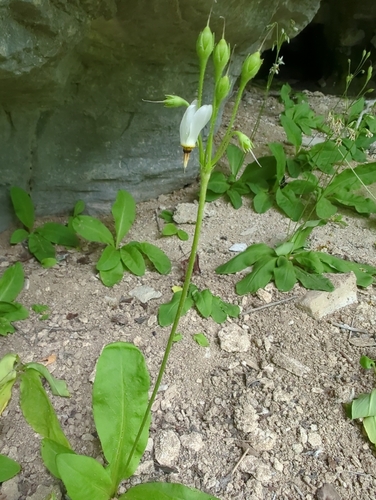
The eastern shooting star is a unique wildflower with distinct downward-pointing, cyclamen-like petals, often white, pink, or purple, fused at the base. Its central beak-like structure points upwards, contrasting with the reflexed petals, giving it an arrow-in-flight appearance.
Category
PlantsRarity
Common
Danger
1/5 · Very low
Snaps
13
Its unique flower shape encourages special bees for pollination!
Some Indigenous peoples historically used its roots for medicinal teas.
The petals look like shooting stars, flying through the spring forest!
This plant loves moist, rich soil, often found near streams and meadows.
Eastern shooting star has petals that bend backward, creating a landing platform for long-tongued insect pollinators like bees.
Eastern shooting star can send roots deep into the soil, helping it survive dry periods and access water.
Eastern shooting star has adapted to bloom early in spring, capturing sunlight before trees fully leaf out.
Its seed capsule shakes in the wind, slinging seeds away to help new plants grow elsewhere.
Bombus impatiens
Utilizes buzz pollination to access hard-to-reach pollen.
Apis mellifera
Gathers nectar and pollen from the distinctive blossoms.

Syrphus ribesii
Feeds on nectar, aiding in pollination.

Otiorhynchus sulcatus
Larvae feed on the plant's roots underground.
Flowering plants are any plants that produce flowers as part of their reproductive cycle.
Cluster flowers are inflorescences where individual flowers are arranged closely together on a common stem.
Shade tolerant plants are adapted to grow and thrive in areas with low light levels, requiring less direct sunlight.
Spring blooming plants produce their flowers during the spring season, often signifying the end of winter and the start of new growth.

Fragrant flowers emit a pleasant aroma, often to attract pollinators or for defense.

Grassland habitats are terrestrial biomes dominated by grasses and herbaceous plants, supporting a variety of grazing animals.

Describes plants that are particularly attractive and beneficial to a wide range of pollinating organisms.

Forest habitats are terrestrial environments dominated by dense tree cover, supporting a high diversity of plant and animal life.
No aliases listed yet.
Danger
1/5 · Very low
Don't pick flowers without asking an adult first, so everyone can enjoy them!
The easiest way to identify eastern shooting star is to use the Snappit nature identifier app.
30-50 cm
15-30 cm
1-2.5 cm
Spring
No
Mild
Perennial
Zoom in to split clusters and explore where this object has been snapped.
May 6, 2026
Bat Cave and Cascade Caverns State Nature PreservesPhoto attribution
(c) Anna Hess, some rights reserved (CC BY)
License: CC BY 4.0 ↗
Image may be shown cropped inside the card frame.

Arkansas, US
You might spot Widow's-Cross, Yucca Giant-Skipper, and Outis Skipper.
View guide →

Illinois, US
You might spot Osage-Orange, Cutleaf Teasel, and Red Clover.
View guide →

Wisconsin, US
You might spot Eastern Forktail and Brown-Belted Bumble Bee.
View guide →

Kentucky, US
You might spot Large White Trillium and Sharp-Lobed Hepatica.
View guide →

Wisconsin, US
You might spot Green Comet Milkweed, Wood Lily, and Flowering Spurge.
View guide →

Illinois, US
You might spot Large White Trillium and Virginia Bluebells.
View guide →
Take the discovery with you
Snap it with Snappit to identify it, learn what makes it special, and add the discovery to your collection.






.jpg&width=800)


_001.jpg&width=800)



