
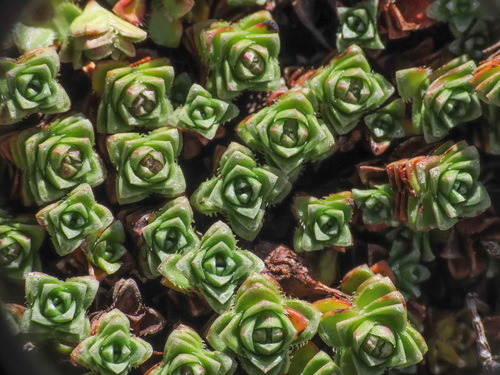


Purple Saxifrage
saxifraga oppositifolia
Meet the Purple Saxifrage (Saxifraga oppositifolia), a botanical marvel celebrated for its unmatched resilience in the face of some of the harshest environments on Earth. This low-growing, evergreen perennial is famous for being one of the northernmost flowering plants in the world, thriving in barren arctic tundras and high-altitude alpine zones where few other species can survive. As winter recedes, it is often the very first plant to bloom, paint-splattering the rocky, desolate landscapes with vibrant splashes of purple and pink long before other flora awaken. Beyond its stunning aesthetic appeal, the Purple Saxifrage is a master of survival. It forms tight, low-lying cushions that hug the ground to escape freezing winds and trap radiant heat. This species plays a crucial role in fragile polar and alpine ecosystems, offering early-season nectar to brave pollinators and nourishing local herbivores. It stands as a symbol of endurance and natural beauty in the frozen wild.
Habitat: Found in rocky arctic and alpine environments, typically growing on gravel, scree slopes, limestone cliffs, and barren tundra.
The Purple Saxifrage is easily identified by its dense, mat-forming growth habit, creating low cushions that typically stand only 2 to 15 centimeters tall but can spread up to 30 centimeters wide. Its tiny, scale-like leaves are stalkless, thick, and grow in opposite, overlapping pairs along creeping woody stems, often tipped with tiny lime-secreting pores. The flowers are remarkably large relative to the plant, cup-shaped, and display five petals ranging in color from pale pink to deep, royal purple. They bloom individually at the ends of the short stems, blanketing the green foliage underneath.
Category
PlantsRarity
Common
Danger
1/5 · Very low
Snaps
Be the first to snap!
Because of its dark-colored flowers and cushion habit, it acts like a solar collector, warming up to absorb sunlight and melt surrounding snow.
It holds the record for being one of the northernmost growing flowering plants on Earth, found at over 83 degrees North latitude in northern Greenland.
The Purple Saxifrage is the official floral emblem of Nunavut, Canada, symbolizing resilience and beauty in the North.
Grows in tight, low-lying mats that trap warm air and block cold winds, keeping the internal temperature up to several degrees warmer than the surrounding air.
Synthesizes specialized sugars and proteins that prevent ice crystals from damaging cell walls, allowing it to survive extreme sub-zero temperatures.
Possesses specialized lime glands at the leaf tips that excrete excess calcium carbonate, forming a protective white crust that helps reflect intense alpine UV radiation.
As a photosynthetic plant, it generates its own energy from sunlight, water, and carbon dioxide, while absorbing essential minerals from thin, rocky soils.
Bombus polaris
Provides essential early-spring nectar and pollen to the Arctic Bumblebee in harsh environments.

Lepus arcticus
Graze on the nutrient-rich leaves and buds of the plant during the spring thaw.

Rangifer tarandus
Feeds on the early blooms and foliage to supplement its diet in the high arctic.
No trait badges are assigned for this object yet.
No aliases listed yet.
Collections for this object will appear here as more themes are added.
Danger
1/5 · Very low
No special safety notes yet.
Start with the whole plant, then compare leaf arrangement, leaf edges, stems and any flowers or fruit. Opposite leaves grow in pairs; alternate leaves come one at a time along the stem. These details tell you far more together than a single green leaf does. Plant Identifier: upload a photo and compare the visible details.
2-15 cm
0.01-0.2 kg
10-100 years
As a photosynthetic plant, it generates its own energy from sunlight, water, and carbon dioxide, while absorbing essential minerals from thin, rocky soils.
Found in rocky arctic and alpine environments, typically growing on gravel, scree slopes, limestone cliffs, and barren tundra.
Zoom in to split clusters and explore where this object has been snapped.
Recent snaps will appear here as new observations are added.
Take the discovery with you
Snap it with Snappit to identify it, learn what makes it special, and add the discovery to your collection.


















