
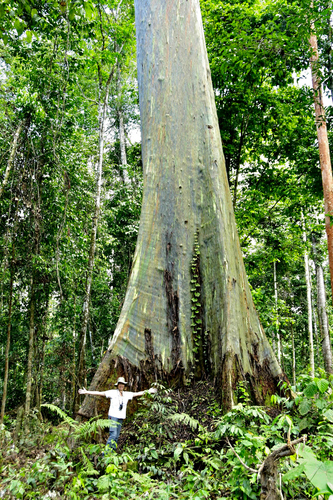


Rainbow Gum
eucalyptus deglupta
The Rainbow Gum (Eucalyptus deglupta) is one of the most stunning and unique trees on Earth, renowned for its spectacular, multicolored bark that looks like a living abstract painting. As the only eucalyptus species native to the Northern Hemisphere, it thrives in warm, humid tropical rainforests. It is an exceptionally fast-growing evergreen tree that can reach towering heights in its natural habitat. Beyond its aesthetic appeal, the Rainbow Gum plays an important ecological role in its native ecosystems, stabilizing riverbanks and providing habitat for various tropical species. While highly prized as an ornamental tree in botanical gardens worldwide, it is also cultivated in large-scale plantations for the production of high-quality paper pulp. Observing a mature specimen in the wild is an unforgettable experience, as its trunk changes colors continuously throughout the seasons, offering a vibrant display of nature's artistry.
Habitat: Found in humid tropical rainforests, typically growing along riverbanks and in areas with high rainfall and rich, moist soils.
The most defining feature of the Rainbow Gum is its smooth, multicolored trunk, which showcases a shifting mosaic of bright green, blue, purple, orange, pink, and deep maroon. This rainbow effect occurs as patches of the outer bark peel away at different times of the year, revealing the vivid green inner bark underneath, which then matures and darkens into other hues. The tree is a giant, capable of reaching heights of 30 to 75 meters in the wild, with a straight trunk and a crown of cascading, lance-shaped green leaves that release a pleasant, typical eucalyptus aroma when crushed. It produces clusters of small, delicate, white to cream-colored flowers.
Category
PlantsRarity
Common
Danger
1/5 · Very low
Snaps
Be the first to snap!
Because it grows so incredibly fast, it is a preferred species for reforestation projects and paper pulp plantations in tropical regions.
It is the only species of Eucalyptus tree native to the Northern Hemisphere.
The spectacular bark colors are completely natural and result from the aging of chlorophyll and tannins as the bark is exposed to air.
Peels its bark in staggered sections, exposing fresh green layers that chemically react with air to transition through shades of blue, purple, orange, and red.
Boasts one of the fastest growth rates of any tree, allowing young saplings to shoot up to 3 meters per year to quickly capture canopy sunlight.
Maintains a robust root system capable of withstanding saturated soils and seasonal flooding along tropical river banks.
As a plant, the Rainbow Gum generates its own energy through photosynthesis, utilizing sunlight, carbon dioxide, water, and essential soil minerals.
Coptotermes gestroi
A common subterranean termite that nests in and feeds on the wood of dead or stressed Rainbow Gum trees.
Pisolithus tinctorius
Ectomycorrhizal fungi that form a symbiotic relationship with the tree's roots, aiding in nutrient and water absorption.
Apis mellifera
Pollinators attracted to the sweet-scented white blossoms of the tree, facilitating reproduction.
No trait badges are assigned for this object yet.
No aliases listed yet.
Collections for this object will appear here as more themes are added.
Danger
1/5 · Very low
No special safety notes yet.
Start with the whole plant, then compare leaf arrangement, leaf edges, stems and any flowers or fruit. Opposite leaves grow in pairs; alternate leaves come one at a time along the stem. These details tell you far more together than a single green leaf does. Plant Identifier: upload a photo and compare the visible details.
3000-7500 cm
50-150 years
As a plant, the Rainbow Gum generates its own energy through photosynthesis, utilizing sunlight, carbon dioxide, water, and essential soil minerals.
Found in humid tropical rainforests, typically growing along riverbanks and in areas with high rainfall and rich, moist soils.
Zoom in to split clusters and explore where this object has been snapped.
Recent snaps will appear here as new observations are added.
Take the discovery with you
Snap it with Snappit to identify it, learn what makes it special, and add the discovery to your collection.


















