

Red-Legged Partridge
alectoris rufa
The Red-Legged Partridge is a striking and charismatic gamebird native to southwestern Europe, renowned for its vibrant coloring and social behavior. Often seen in small groups called 'coveys,' this terrestrial bird prefers to outrun danger rather than fly, scurrying across open fields with surprising agility. Its distinctively patterned plumage and bright red legs make it a beloved sight among birdwatchers and nature enthusiasts alike. Despite facing threats from modern agricultural practices and habitat loss, it remains an iconic species of sunny, open landscapes, epitomizing the rustic charm of rural European scrublands and dry farmlands.
Habitat: Typically found in dry, open lowland habitats such as agricultural fields, vineyards, sandy heathlands, and Mediterranean-style scrublands.
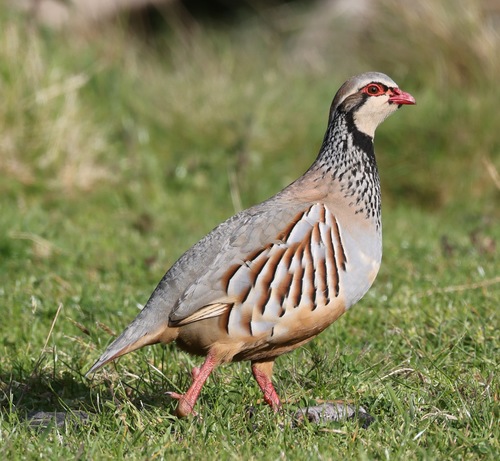
This medium-sized bird is instantly recognizable by its bright red bill, red eye-rings, and prominent pinkish-red legs. It features a clean white throat patch sharply bordered by a black collar that dissolves into delicate speckling across its upper breast. Its upperparts are a warm sandy-brown, while its flanks are beautifully adorned with bold, vertical bars of black, white, and rich chestnut. When flushed, it reveals short, rounded wings and a chestnut-banded tail.
Category
BirdsRarity
Common
Danger
1/5 · Very low
Snaps
Be the first to snap!
Its scientific name, Alectoris, comes from the Ancient Greek word for 'chicken' or 'cock', reflecting its chicken-like appearance and behavior.
To help digest tough seeds and plant matter, this bird swallows small stones and grit, which grind down food inside its muscular gizzard.
Unlike many other gamebirds, the Red-Legged Partridge is highly social and lives in tight-knit family groups called 'coveys' during the winter months.
Prefers running over flying to evade predators, utilizing its strong red legs to dash through dense undergrowth at remarkable speeds.
Females sometimes lay two separate clutches of eggs in different nests simultaneously, with the male incubating one while she incubates the other.
The bold, vertical barring on its flanks disrupts its outline against dry grasses and dappled sunlight, keeping it hidden from aerial predators.
Primarily herbivorous, feeding on seeds, leaves, and roots, but incorporates small invertebrates into its diet, especially during the breeding season.
Age differences: Chicks feed almost exclusively on high-protein insects like ants and beetles for their first few weeks before transitioning to a seed-based diet.

Vulpes vulpes
The Red Fox is a primary ground predator, targeting both adult partridges and their ground-nested eggs.
Perdix perdix
Competes directly for food, territory, and suitable nesting sites in shared agricultural landscapes.
Circus cyaneus
This bird of prey hunts over open fields, occasionally preying on young or adult partridges.
No trait badges are assigned for this object yet.
No aliases listed yet.
Collections for this object will appear here as more themes are added.
Danger
1/5 · Very low
No special safety notes yet.
Compare the silhouette, bill shape, tail length, wing bars and markings around the eyes. The same small brown bird at your feeder can look quite different in breeding plumage, winter plumage or its first year. Bird Identifier: upload a photo and compare the visible details.
32+ cm
45+ cm
0.4+ kg
3+ years
60 km/h
Primarily herbivorous, feeding on seeds, leaves, and roots, but incorporates small invertebrates into its diet, especially during the breeding season.
Typically found in dry, open lowland habitats such as agricultural fields, vineyards, sandy heathlands, and Mediterranean-style scrublands.
Zoom in to split clusters and explore where this object has been snapped.
Recent snaps will appear here as new observations are added.
Take the discovery with you
Snap it with Snappit to identify it, learn what makes it special, and add the discovery to your collection.