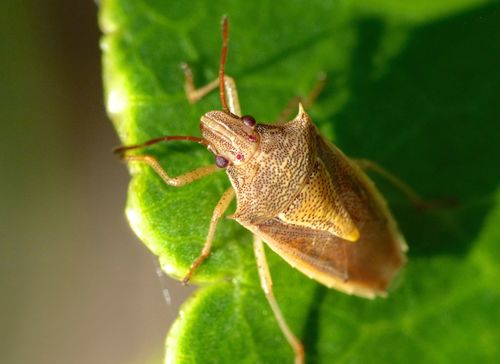


Rice Stink Bug
oebalus pugnax
The Rice Stink Bug (Oebalus pugnax) is a slender, straw-colored true bug widely known as a notable agricultural pest in the Americas. Primarily associated with rice fields and wild grasses, this insect plays a significant role in agricultural ecosystems. Although often feared by farmers due to the cosmetic and structural damage it causes to maturing grain heads, it is a fascinating subject for nature enthusiasts who appreciate the intricate world of true bugs. Equipped with specialized piercing-sucking mouthparts, the Rice Stink Bug feeds on the developing seeds of grasses, extracting vital nutrients. While it can be a nuisance for crop yields, its survival strategies, including the production of defensive chemical compounds and its distinct structural adaptations, highlight the impressive evolutionary success of the Pentatomidae family.
Habitat: Found in warm, agricultural regions, primarily in and around cultivated rice fields, wet meadows, and areas with tall wild grasses.
This insect is easily recognized by its narrow, elongated, shield-shaped body, which typically measures between 1.0 and 1.2 centimeters in length. Its coloration ranges from a light straw-yellow to a pale tan, allowing it to blend seamlessly with dry grasses and agricultural crops. A key distinguishing feature is the presence of two sharp, forward-pointing spines on the lateral shoulders of its pronotum. Additionally, its wings fold flat over its back, displaying a distinct dark pattern near the rear of the abdomen, while its long, slender antennae extend forward to help it navigate.
Category
InsectsRarity
Common
Danger
1/5 · Very low
Snaps
Be the first to snap!
The Rice Stink Bug leaves distinct dark spots on rice grains known as 'pecky rice', which lowers the grain's quality and market value.
Their eggs are uniquely barrel-shaped and are laid in neat, double-row chains on the leaves of grass host plants.
To survive cold winters, adult bugs undergo diapause, seeking shelter under leaf litter, bark, or bunchgrasses until spring warm-up.
When threatened, it releases a pungent, foul-smelling liquid from thoracic glands to deter predators like birds and spiders.
Equipped with a specialized rostrum, it can pierce tough plant tissues and hulls to suck out liquefied starch from developing grains.
The sharp, forward-pointing humeral spines on its shoulders make it more difficult and painful for small predators to swallow.
Feeds almost exclusively on the seeds, grains, and floral parts of grasses, particularly rice during its milky and dough development stages.
Age differences: Nymphs and adults feed on the same host plants, but younger nymphs prefer tender, easily pierced plant tissues.
Telenomus podisi
A tiny parasitic wasp that attacks and develops inside the eggs of the rice stink bug, acting as a natural biological control.

Oryza sativa
The primary cultivated food source for both nymphs and adults, providing the starch and nutrients needed for their development.
Coleomegilla maculata
Preys upon the eggs and early-stage nymphs of the rice stink bug in agricultural fields.
No trait badges are assigned for this object yet.
No aliases listed yet.
Collections for this object will appear here as more themes are added.
Danger
1/5 · Very low
No special safety notes yet.
Look for six legs, antennae, three body sections and the shape of the wings. Beetles have hardened front wings; flies have just one working pair. Tiny insects may need a close view before their group is clear. Insect Identifier: upload a photo and compare the visible details.
1-2 cm
up to 1 years
Feeds almost exclusively on the seeds, grains, and floral parts of grasses, particularly rice during its milky and dough development stages.
Found in warm, agricultural regions, primarily in and around cultivated rice fields, wet meadows, and areas with tall wild grasses.
Grazing
10-50
4-8 days
Zoom in to split clusters and explore where this object has been snapped.
Recent snaps will appear here as new observations are added.
Take the discovery with you
Snap it with Snappit to identify it, learn what makes it special, and add the discovery to your collection.