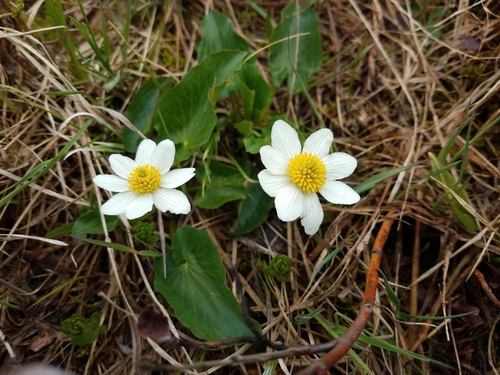


Rocky Mountain Marsh-Marigold
caltha chionophila
The Rocky Mountain Marsh-Marigold (Caltha chionophila) is a remarkable high-altitude wildflower known for heralding the arrival of spring in alpine and subalpine environments. Emerging remarkably early in the season, this resilient plant is famous for pushing its bright blossoms directly through the edges of melting snowbanks. A member of the buttercup family, it thrives in wet, marshy conditions, often blanketing boggy meadows and high-elevation stream banks with a striking display of white or pale yellow blooms. Despite its fragile appearance, the Rocky Mountain Marsh-Marigold is incredibly tough. It possesses specialized antifreeze-like properties and deep root systems that allow it to survive extreme temperature fluctuations. This perennial beauty not only provides an uplifting sight for early-season hikers but also serves as a crucial food source for newly emerged pollinators and foraging alpine mammals after long, harsh winters.
Habitat: Typically found in wet alpine and subalpine meadows, seeps, and along the banks of high-elevation streams, frequently blooming at the immediate edges of receding snowbanks.
Caltha chionophila is characterized by its glossy, dark green, somewhat fleshy basal leaves that are heart-shaped or kidney-shaped with gently scalloped margins. The plant lacks true petals; instead, it features 5 to 15 showy, petal-like sepals that are typically brilliant white, sometimes tinged with faint blue or pale yellow on their undersides. These bowl-shaped blossoms measure about 2 to 4 centimeters across and cup a dense, bright yellow central cluster of numerous stamens and pistils. It generally grows in low, mounding clumps reaching 5 to 15 centimeters in height, making it prominent against barren or snow-dusted early spring soils.
Category
PlantsRarity
Common
Danger
1/5 · Very low
Snaps
3
Because they bloom so early, their bowl-shaped flowers track the sun to capture heat, acting as tiny parabolic heaters that keep visiting insects warm.
Its species name, chionophila, translates from Greek to mean 'snow-loving', a perfect descriptor for a plant that pushes up through melting snow.
The Rocky Mountain Marsh-Marigold has no actual petals; the white, showy parts of the flower are technically modified leaves called sepals.
They belong to the buttercup family, which means they contain toxic alkaloids that can irritate the skin or cause digestive issues if eaten raw by humans.
Emerges and blooms while the ground is still partially frozen, often pushing its flowers straight through thin layers of melting snow.
Utilizes specialized physiological mechanisms, including the accumulation of sugars in its tissues, to prevent cellular freezing during sudden alpine frosts.
Features a prominent bowl-shaped flower that acts like a parabolic reflector, concentrating the sun's warmth to attract and heat early-emerging insects.
Like all green plants, the Rocky Mountain Marsh-Marigold creates its own food through photosynthesis.
Cervus canadensis nelsoni
Rocky Mountain Elk often graze on the foliage during early spring when other food is scarce.
Ochotona princeps
American Pikas harvest the leaves to add to their winter haypiles.
Osmia lignaria
Early emerging solitary bees rely heavily on the nectar and pollen of the marsh-marigold.
No trait badges are assigned for this object yet.
No aliases listed yet.
Collections for this object will appear here as more themes are added.
Danger
1/5 · Very low
No special safety notes yet.
The easiest way to identify Rocky Mountain Marsh-Marigold is to use the Snappit nature identifier app.
5-15 cm
5-20 years
Like all green plants, the Rocky Mountain Marsh-Marigold creates its own food through photosynthesis.
Typically found in wet alpine and subalpine meadows, seeps, and along the banks of high-elevation streams, frequently blooming at the immediate edges of receding snowbanks.
Photosynthesis
Zoom in to split clusters and explore where this object has been snapped.
Take the discovery with you
Snap it with Snappit to identify it, learn what makes it special, and add the discovery to your collection.













.jpg&width=800)



_001.jpg&width=800)




