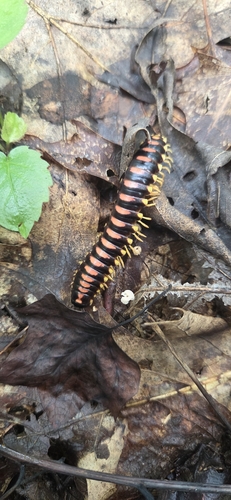


Rudiloria Trimaculata
rudiloria trimaculata
Rudiloria trimaculata is a striking millipede belonging to the family Xystodesmidae, widely appreciated for its vivid warning coloration and flat-backed appearance. Native to the damp, deciduous forests of eastern North America, this fascinating arthropod is a gentle giant of the leaf litter. As a vital part of the forest ecosystem, it works tirelessly as a detritivore, breaking down decaying plant matter and recycling nutrients back into the soil. What makes R. trimaculata truly remarkable is its chemical defense mechanism; when threatened, it can secrete a fluid containing hydrogen cyanide, emitting an odor akin to bitter almonds to deter predators.
Habitat: Found in the moist, shaded leaf litter and decaying logs of mature deciduous forests in eastern North America.
This millipede features a distinctly flat-backed (polydesmid) body shape, with lateral extensions called paranota on each segment. As its specific epithet 'trimaculata' implies, it is beautifully adorned with three distinct, brightly colored spots—typically yellow, orange, or red—across each of its dark brown or black dorsal segments, consisting of one central spot and two lateral spots. It lacks eyes entirely, relying instead on antennae to navigate its dark, humid environment. Despite the name 'millipede', it possesses nowhere near a thousand legs, having one pair on the first few segments and two pairs on the remaining body segments.
Category
AnimalRarity
Common
Danger
1/5 · Very low
Snaps
1
Despite the name 'millipede' meaning 'thousand feet', this species has fewer than 100 legs, possessing exactly two pairs on most of its body segments.
Its species name, 'trimaculata', translates directly to 'three-spotted', perfectly describing the striking trio of colored dots on each body segment.
Like all species in the order Polydesmida, it is completely blind and navigates the dark leaf litter entirely by touch and smell.
Rudiloria trimaculata smells strongly of cherry cola or bitter almonds when disturbed, a clear chemical warning that it is secreting toxic hydrogen cyanide gas.
Secretes hydrogen cyanide and benzaldehyde when threatened to deter predators, which smells strongly of bitter almonds.
Uses bright, contrasting three-spotted patterns on its segments as a visual warning to potential predators about its toxicity.
Being completely eyeless, it relies on highly sensitive antennae and tactile hairs to navigate and locate food in the dark leaf litter.
Feeds primarily on decaying organic matter, playing a crucial role in nutrient cycling within the forest floor.
Age differences: Juveniles consume softer, more highly decomposed organic matter, while adults can process tougher leaf litter and woody debris.
Trametes versicolor
Forages on decaying wood broken down by fungi, utilizing the fungus as both a dietary supplement and a processing agent.
Phengodes laticollis
Hunted by specialized glowworm beetles whose larvae feed almost exclusively on toxic millipedes.

Blarina brevicauda
Shares the leaf litter habitat but is generally avoided due to its chemical defenses.
No trait badges are assigned for this object yet.
No aliases listed yet.
Collections for this object will appear here as more themes are added.
Danger
1/5 · Very low
No special safety notes yet.
Start with body shape, legs or fins, fur, feathers or scales, and standout markings. Then weigh size, habitat and where you saw it. Young animals and seasonal coats can look very different from familiar adults. Animal Identifier: upload a photo and compare the visible details.
3-5 cm
0.001-0.005 kg
1-3 years
Feeds primarily on decaying organic matter, playing a crucial role in nutrient cycling within the forest floor.
Found in the moist, shaded leaf litter and decaying logs of mature deciduous forests in eastern North America.
Foraging
50-300
Zoom in to split clusters and explore where this object has been snapped.
Take the discovery with you
Snap it with Snappit to identify it, learn what makes it special, and add the discovery to your collection.