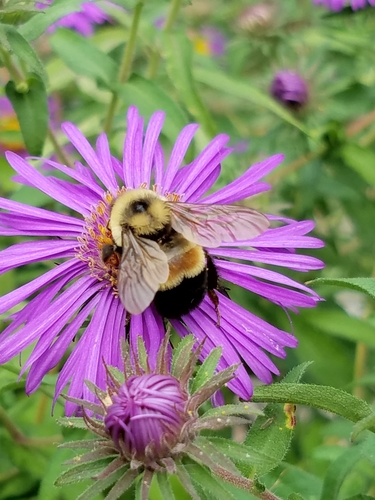


Rusty-Patched Bumble Bee
bombus affinis
The Rusty-Patched Bumble Bee (Bombus affinis) is a vital native pollinator of the eastern United States and Upper Midwest, famed for its key role in maintaining wildflower diversity and agricultural productivity. Once a common sight buzzing through grasslands, orchards, and gardens, this species has tragically suffered a catastrophic decline of over 87% in recent decades. As the first bumble bee species to be listed under the U.S. Endangered Species Act, it serves as a powerful symbol for insect conservation efforts across North America. These bees are highly social insects that form annual colonies. In early spring, solitary queens emerge from underground winter hibernation to establish new nests, typically in abandoned rodent burrows. Throughout the summer, diligent workers forage tirelessly, utilizing complex flight and sensory capabilities to gather nectar and pollen. By supporting this delicate pollinator, we protect entire ecosystems that rely on their highly efficient pollination services.
Habitat: Typically found in temperate grasslands, open prairies, woodlands, wetlands, and urban parks with abundant wildflowers and nearby abandoned rodent burrows for nesting.
Workers and males of the Rusty-Patched Bumble Bee are identified by a distinctive, reddish-brown patch on the center of their second abdominal segment, which is completely surrounded by yellow. The rest of the abdomen is black, and the thorax is mostly yellow with a black band or patch between the wing bases. The head is entirely black. Queens are significantly larger than workers and do not have the rusty patch, instead displaying a yellow first abdominal segment and a black remainder. Their bodies are round, covered in dense, velvety hair, with a wingspan ranging from 2 to 4 centimeters.
Category
InsectsRarity
Common
Danger
1/5 · Very low
Snaps
3
They are excellent thermoregulators, capable of raising their internal temperature to 30 degrees Celsius (86 degrees Fahrenheit) above the ambient air temperature.
They can fly at speeds of up to 16 kilometers per hour while foraging for nectar and pollen.
They were the first bumble bee species in the United States to be officially added to the federal endangered species list in 2017.
They grasp flowers and rapidly vibrate their flight muscles to release pollen from deep within tubular pores.
They can shiver their flight muscles to generate body heat, allowing them to fly and forage in colder temperatures than many other insects.
When flowers are too deep, they chew a hole at the base of the corolla to feed directly on nectar, bypassing standard pollination.
Feeds exclusively on pollen and nectar from a wide variety of native wildflowers, shrubs, and agricultural crops.

Monarda fistulosa
Provides nectar and pollen, while the bee acts as its primary pollinator.
Bombus ashtoni
The cuckoo bumble bee is an obligate social parasite that invades nests, kills the queen, and forces workers to raise its young.
Microtus pennsylvanicus
Creates underground burrows that are later utilized by bumble bee queens to establish their colonies.
No trait badges are assigned for this object yet.
No aliases listed yet.
Collections for this object will appear here as more themes are added.
Danger
1/5 · Very low
No special safety notes yet.
The easiest way to identify Rusty-Patched Bumble Bee is to use the Snappit nature identifier app.
1-2 cm
2-4 cm
0.0001-0.0008 kg
0-1 years
16 km/h
Feeds exclusively on pollen and nectar from a wide variety of native wildflowers, shrubs, and agricultural crops.
Typically found in temperate grasslands, open prairies, woodlands, wetlands, and urban parks with abundant wildflowers and nearby abandoned rodent burrows for nesting.
Zoom in to split clusters and explore where this object has been snapped.

Wisconsin, US
You might spot Common Eastern Bumble Bee, Bee, and Monarch.
View guide →

Iowa, US
You might spot Common Eastern Bumble Bee, American Pokeweed, and Bluegill.
View guide →

Illinois, US
You might spot Common Eastern Bumble Bee and Brown-Belted Bumble Bee.
View guide →
Take the discovery with you
Snap it with Snappit to identify it, learn what makes it special, and add the discovery to your collection.












.jpg&width=800)




