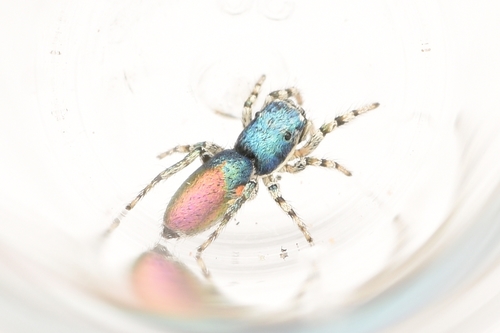


Salticus Peckhamae
salticus peckhamae
The Peckham's Zebra Spider (Salticus peckhamae) is a captivating tiny acrobat of the arachnid world, belonging to the diverse jumping spider family Salticidae. Named in honor of the legendary 19th-century arachnologists George and Elizabeth Peckham, this minuscule predator is celebrated for its incredible agility and keen intellect. Unlike web-weaving spiders, Salticus peckhamae relies on active hunting, using its exceptionally sharp vision to navigate its surroundings and stalk small insects with cat-like precision. It is a delightful find for nature enthusiasts, often seen executing dramatic leaps across sunny vertical surfaces. Its inquisitive nature, characterized by tilts of its head-like cephalothorax when observing onlookers, makes it one of the most charismatic micro-fauna species in its habitat.
Habitat: Found in dry oak woodlands, chaparral, and coastal scrub, frequently spotted on sun-drenched tree trunks, rocks, and wooden fences.
This tiny spider typically measures between 3 and 5 millimeters in length, featuring a compact, robust body with a distinctively high carapace. Its coloration is a cryptic mosaic of black, grey, white, and bronze scales, forming mottled bands or zebra-like stripes across its abdomen and legs. Its most striking physical feature is its cluster of eight eyes, dominated by two massive, forward-facing anterior median eyes that gleam like tiny black gemstones and provide exceptional binocular vision.
Category
InvertebrateRarity
Common
Danger
1/5 · Very low
Snaps
Be the first to snap!
Before making a daring leap, they always spin a silk dragline, which acts as a safety harness to prevent them from falling to the ground.
They possess an incredibly advanced visual cortex, allowing them to perceive colors and track prey with visual clarity comparable to some vertebrates.
This species is named after George and Elizabeth Peckham, a 19th-century husband-and-wife scientific team who discovered and classified hundreds of jumping spider species.
Utilizes rapid changes in internal fluid pressure to launch itself up to many times its body length without strong leg muscles.
Possesses eight eyes arranged to provide a nearly 360-degree field of view, with specialized front eyes for tracking movement and depth.
Spins and anchors a temporary dragline of silk before leaping, allowing it to climb back up safely if a jump fails.
An active diurnal hunter that stalks small insects and pounces on them with precision, injecting a fast-acting venom to subdue its prey.
Age differences: Spiderlings feed on microscopic prey like springtails and fruit flies, transitioning to larger insects as they mature.
Musca domestica
Preys heavily on this insect on tree trunks
Tachypompilus ferrugineus
Acts as a major predator, paralyzing the spider to feed its larvae

Phidippus audax
Competes for territories and small insect prey in similar microhabitats
No trait badges are assigned for this object yet.
No aliases listed yet.
Collections for this object will appear here as more themes are added.
Danger
1/5 · Very low
No special safety notes yet.
Compare body proportions, leg shape, abdomen markings and the web, if there is one. Eye arrangement can be decisive but rarely shows up in a casual phone photo. A web is a supporting clue, not proof of who built it. Spider Identifier: upload a photo and compare the visible details.
up to 0 cm
0.00001-0.00005 kg
1-2 years
An active diurnal hunter that stalks small insects and pounces on them with precision, injecting a fast-acting venom to subdue its prey.
Found in dry oak woodlands, chaparral, and coastal scrub, frequently spotted on sun-drenched tree trunks, rocks, and wooden fences.
Ambush
10-30
Zoom in to split clusters and explore where this object has been snapped.
Recent snaps will appear here as new observations are added.
Take the discovery with you
Snap it with Snappit to identify it, learn what makes it special, and add the discovery to your collection.