

Scorpion'S-Tail
heliotropium angiospermum
Scorpion's-Tail (Heliotropium angiospermum) is a charming perennial herb native to the tropical and subtropical regions of the Americas. Named for its uniquely curled, scorpion-tail-like flower spikes, this resilient plant is a member of the borage family (Boraginaceae). It is highly appreciated not only for its distinctive architectural beauty but also for its exceptional ecological value, serving as a critical nectar source for many local butterflies and other beneficial pollinators. Whether growing in coastal sandy soils, disturbed areas, or cultivated native gardens, this plant brings life and movement to its surroundings. Its persistent blooms and hardy nature make it an excellent choice for xeriscaping and butterfly gardens in warm climates, where it continuously contributes to local biodiversity.
Habitat: Found in sandy coastal zones, pinelands, hammocks, disturbed sites, and dry fields throughout tropical and subtropical regions.
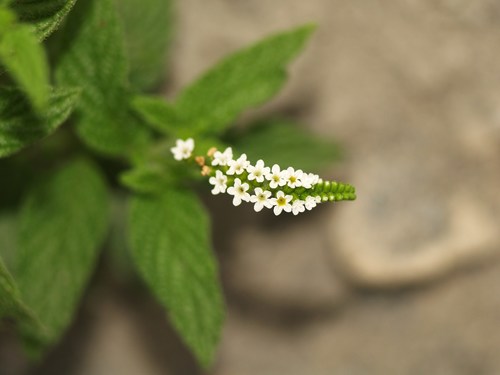
This low-growing, bushy perennial typically reaches heights of 30 to 100 cm. Its lance-shaped to elliptic green leaves have deeply textured, depressed veins that give them a rough, wrinkled appearance. The most defining feature is the terminal, coiled spike of small white flowers. These tiny, five-lobed blossoms open sequentially along the outer curve of the scorpion-like tail, starting from the base and working toward the tip, creating a striking visual pattern.
Category
PlantsRarity
Common
Danger
1/5 · Very low
Snaps
1
In traditional medicine across the Caribbean, leaf extracts of this plant have been used to soothe skin irritations and treat minor wounds.
Male butterflies from the Danainae subfamily visit the flowers specifically to obtain alkaloids required to synthesize courtship pheromones.
The common name 'Scorpion's-tail' and the genus name 'Heliotropium' (meaning 'turn to the sun') both refer to the way the flower spike curls and aligns itself.
The flower spikes coil tightly like a scorpion's tail, presenting blossoms sequentially to ensure continuous pollination over an extended period.
Features deep root systems and textured foliage that help it conserve moisture, enabling survival in arid, sandy, and nutrient-poor soils.
Synthesizes pyrrolizidine alkaloids to deter generalist herbivores and insect pests from feeding on its foliage.
As a photoautotrophic plant, it produces its own energy using sunlight, water, and carbon dioxide through the process of photosynthesis.
Heliconius charithonia
Provides nectar for the adult butterfly, which frequently visits the curled flower spikes.
Danaus gilippus
Male butterflies feed on the nectar to acquire pyrrolizidine alkaloids, which they use to produce courtship pheromones and make themselves unpalatable to predators.
Spodoptera eridania
The larvae of this moth occasionally feed on the leaves of the plant.
No trait badges are assigned for this object yet.
No aliases listed yet.
Collections for this object will appear here as more themes are added.
Danger
1/5 · Very low
No special safety notes yet.
The easiest way to identify Scorpion'S-Tail is to use the Snappit nature identifier app.
30-100 cm
2-5 years
As a photoautotrophic plant, it produces its own energy using sunlight, water, and carbon dioxide through the process of photosynthesis.
Found in sandy coastal zones, pinelands, hammocks, disturbed sites, and dry fields throughout tropical and subtropical regions.
Zoom in to split clusters and explore where this object has been snapped.
Take the discovery with you
Snap it with Snappit to identify it, learn what makes it special, and add the discovery to your collection.












.jpg&width=800)



_001.jpg&width=800)




