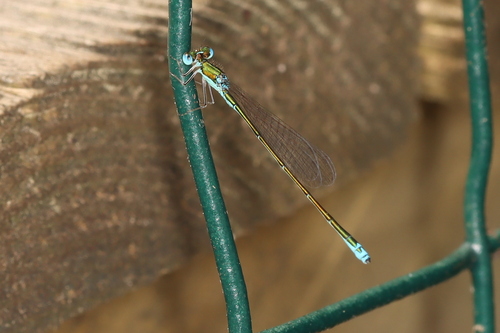


Sedge Sprite
nehalennia irene
The Sedge Sprite (Nehalennia irene) is an exceptionally small and delicate damselfly belonging to the pond damselfly family, Coenagrionidae. Widely distributed across northern North America, this miniature insect is renowned for its brilliant metallic coloration and its secretive lifestyle among dense shoreline vegetation. Unlike larger, more conspicuous dragonflies that patrol open waters, the Sedge Sprite prefers to dwell deep within the protective microforest of sedges, rushes, and grasses bordering wetlands. This species is a reliable bioindicator of healthy, undisturbed wetland ecosystems, requiring clean, still water and rich vegetative structures to complete its life cycle. Watching these tiny sprites hover delicately among grass blades provides a fascinating glimpse into the complex, highly adapted world of wetland insects.
Habitat: Found in densely vegetated wetlands, particularly sedge meadows, fens, bogs, and the quiet edges of marshes and slow-moving streams.
A diminutive damselfly, the Sedge Sprite measures only 2.0 to 2.7 cm in length, with a wingspan of about 2.5 to 3.0 cm. It is easily identified by its metallic bronze-green thorax and abdomen, which shimmer brightly in direct sunlight. The lower sides of its thorax are a contrasting pale yellow or green, and the tip of the abdomen features striking blue markings, particularly on segment 8, which has a distinct blue patch with small black dots. Its wings are clear and narrow, held folded over its back when at rest, and its eyes are large, rounded, and a deep greenish-blue.
Category
InsectsRarity
Common
Danger
1/5 · Very low
Snaps
Be the first to snap!
During mating, the male uses special claspers on his abdomen to hold the female by her prothorax, forming a heart-shaped mating wheel in the grass.
It is one of the smallest damselflies in North America, often overlooked due to its tiny size and habit of staying deep in the grass.
Unlike many dragonflies that migrate or fly long distances, Sedge Sprites rarely travel more than a few dozen meters from their natal wetland.
Flies low and deep within dense sedge grasses to escape strong winds and evade larger aerial predators.
Possesses a metallic green cuticle that reflects surrounding vegetation, making it nearly invisible when perched.
Females exhibit different color morphs, including a male-like andromorph, to reduce excessive mating harassment.
As both aquatic nymphs and aerial adults, Sedge Sprites are voracious predators that feed on a variety of small soft-bodied insects.
Age differences: Nymphs are aquatic predators feeding on microcrustaceans and small insect larvae, while adults hunt flying insects in terrestrial vegetation.
Chironomus plumosus
Preys upon adults and larvae in and around aquatic vegetation.

Lithobates clamitans
Preys on the adult damselflies along the wetland edges.

Anax junius
Large predatory dragonfly larvae that hunt Sedge Sprite nymphs.
No trait badges are assigned for this object yet.
No aliases listed yet.
Collections for this object will appear here as more themes are added.
Danger
1/5 · Very low
No special safety notes yet.
Compare wing shape and resting posture, where the eyes sit, body markings and the tail segments. Males and females can look very different in color. Dragonfly Identifier: upload a photo and compare the visible details.
2-3 cm
2-3 cm
0.00002-0.00008 kg
1 years
8 km/h
As both aquatic nymphs and aerial adults, Sedge Sprites are voracious predators that feed on a variety of small soft-bodied insects.
Found in densely vegetated wetlands, particularly sedge meadows, fens, bogs, and the quiet edges of marshes and slow-moving streams.
Zoom in to split clusters and explore where this object has been snapped.
Recent snaps will appear here as new observations are added.
Take the discovery with you
Snap it with Snappit to identify it, learn what makes it special, and add the discovery to your collection.