

Sesame Leafroller
antigastra catalaunalis
The Sesame Leafroller (Antigastra catalaunalis) is a small, highly active moth belonging to the Crambidae family. Best known for its relationship with sesame crops, this insect is both a marvel of adaptation and a significant challenge for farmers in tropical and subtropical regions. The species is highly migratory, occasionally traveling long distances from warmer climates into temperate parts of Europe. While small, its ecological impact on its host plants is profound. The larvae are clever engineers, constructing delicate silk shelters and rolling leaves to protect themselves from predators while they feed. Observing these tiny creatures reveals the intricate ways in which insects adapt to agricultural landscapes, utilizing human cultivation to expand their populations across the globe.
Habitat: Typically found in agricultural fields, grasslands, and warm disturbed habitats where sesame or wild Scrophulariaceae plants are abundant.
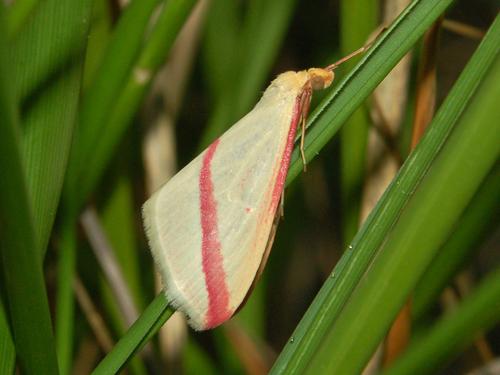
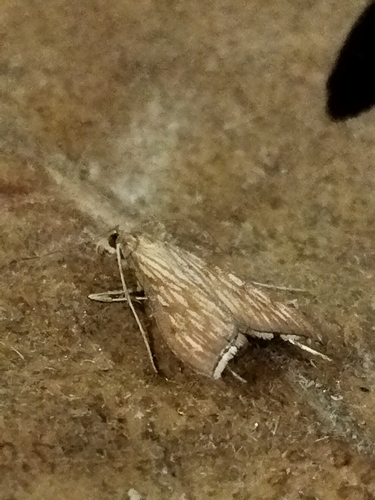
Adult Sesame Leafrollers are small moths with a wingspan of 1 to 2 cm. They feature pale yellow to light orange-brown forewings adorned with distinct reddish-brown veins and a darker wing margin. Their hindwings are lighter, semi-translucent, and fringed with fine hairs. When at rest, they hold their wings in a flat, triangular shape. The larvae are slender, greenish-yellow caterpillars, reaching about 1.5 cm in length, covered in small dark spots and sparse hairs that help them sense their immediate surroundings.
Category
InsectsRarity
Common
Danger
1/5 · Very low
Snaps
Be the first to snap!
Despite their tiny size, adult Sesame Leafrollers are strong flyers that migrate across the Mediterranean Sea from Africa to Europe.
Their feeding behavior can cause significant economic damage, sometimes destroying up to ninety percent of a sesame crop if left unchecked.
To stay safe while eating, the caterpillar ties leaves together with silk, creating a custom shelter that keeps it hidden from birds.
The larvae use silk threads to roll up or tie host plant leaves together, creating a private, protective shelter to feed in safety.
When leaves mature, larvae transition to boring directly into seed pods, shielding themselves from insecticides and predators.
When disturbed, the caterpillar wriggles rapidly backward and drops from the leaf, suspended by a silk lifeline to escape predators.
Larvae feed voraciously on the leaves, flowers, shoots, and young pods of sesame and related plants, while adults drink nectar.
Age differences: Young larvae graze on leaf surfaces, while older larvae roll leaves and bore directly into stems and seed pods.
Sesamum indicum
The primary larval host plant, where caterpillars feed on leaves and bore into developing pods.
Bracon hebetor
A parasitoid wasp that attacks and lays eggs inside the caterpillars of the leafroller, helping to control its population.
Antirrhinum majus
An alternative host plant where the leafroller larvae feed on leaves and flowers when sesame is unavailable.
No trait badges are assigned for this object yet.
No aliases listed yet.
Collections for this object will appear here as more themes are added.
Danger
1/5 · Very low
No special safety notes yet.
Compare resting wing shape, forewing markings, antennae and body build. Small brown moths can hinge on fine details a phone photo can't always catch. Moth Identifier: upload a photo and compare the visible details.
1-2 cm
1-2 cm
0.00001-0.00004 kg
0-1 years
10 km/h
Larvae feed voraciously on the leaves, flowers, shoots, and young pods of sesame and related plants, while adults drink nectar.
Typically found in agricultural fields, grasslands, and warm disturbed habitats where sesame or wild Scrophulariaceae plants are abundant.
Zoom in to split clusters and explore where this object has been snapped.
Recent snaps will appear here as new observations are added.
Take the discovery with you
Snap it with Snappit to identify it, learn what makes it special, and add the discovery to your collection.