
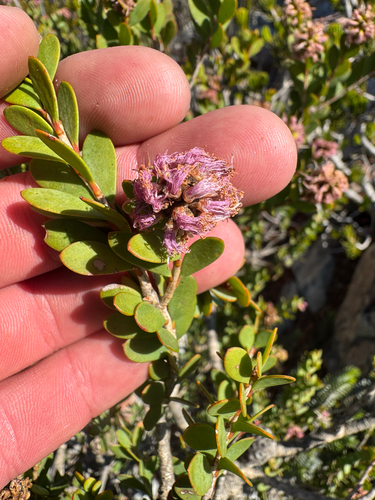


Showy Honey-Myrtle
melaleuca nesophila
The Showy Honey-Myrtle (Melaleuca nesophila) is an exceptionally hardy, evergreen shrub or small tree native to the coastal sand dunes and granite outcrops of southwestern Western Australia. Renowned for its spectacular, spherical flower heads, this member of the Myrtaceae family serves as both an ornamental marvel and a robust ecological anchor. It can grow up to six meters in height and width, presenting a dense, rounded habit with beautiful papery bark and small, thick leaves that release a pleasant, aromatic scent when crushed. In addition to its beauty, the Showy Honey-Myrtle is celebrated for its extreme resilience to salt spray, drought, and poor soils. This makes it a popular choice for coastal windbreaks, soil erosion control, and urban landscaping in Mediterranean climates globally. Its nectar-rich blooms serve as a vital lifeline for countless native pollinators, ensuring local ecosystems thrive.
Habitat: Found primarily in coastal heathlands, shrublands, and on granite outcrops in sandy or rocky soils in southwestern Australia.
This species is distinguished by its dense, globose 'pom-pom' flower heads that measure about 2 to 3 cm in diameter. The flowers emerge as a striking deep pink to lavender with bright golden-yellow tipped stamens, slowly fading to clean white over time. The foliage consists of small, alternate, obovate to elliptic gray-green leaves arranged closely along the branches. The mature bark is thick, spongy, and deeply fissured, peeling away in papery white or light brown layers. Following pollination, clusters of woody, cup-shaped seed capsules form closely along the stems, resembling tight, bumpy rings.
Category
PlantsRarity
Common
Danger
1/5 · Very low
Snaps
Be the first to snap!
Its pom-pom-like flowers naturally change color from a deep pinkish-purple to pristine white as they age, creating a spectacular multi-colored canopy on a single plant.
The species name 'nesophila' is derived from ancient Greek words meaning 'island-loving', a nod to the offshore islands of Western Australia where it was first collected.
The spongy, thick, papery bark characteristic of this species acts as natural insulation, protecting the delicate inner cambium layer of the trunk from moderate bushfires.
The leaves possess a thick, waxy cuticle and specialized cells that allow the plant to withstand harsh, salt-laden winds in coastal environments without dehydrating.
Seeds are sealed inside hard, woody capsules that remain on the branches for years, opening to release seeds only after the heat of a bushfire or the death of the branch.
Equipped with a woody swelling at the base of the stem called a lignotuber, which contains dormant buds and energy reserves, enabling the plant to quickly resprout after severe drought or fire.
The Showy Honey-Myrtle is a photosynthetic plant that converts solar energy, carbon dioxide, and water into sugars, relying on its roots to absorb essential nutrients from the soil.
Phylidonyris novaehollandiae
Visits flowers to feed on nectar, acting as a crucial pollinator for the species.
Amegilla cingulata
Forages on the blossoms, consuming pollen and nectar while assisting in cross-pollination.
Tarsipes rostratus
Feeds on the high-energy nectar of the flowers in its native coastal southwestern Australian range.
No trait badges are assigned for this object yet.
No aliases listed yet.
Collections for this object will appear here as more themes are added.
Danger
1/5 · Very low
No special safety notes yet.
Start with the whole plant, then compare leaf arrangement, leaf edges, stems and any flowers or fruit. Opposite leaves grow in pairs; alternate leaves come one at a time along the stem. These details tell you far more together than a single green leaf does. Plant Identifier: upload a photo and compare the visible details.
100+ cm
20+ years
The Showy Honey-Myrtle is a photosynthetic plant that converts solar energy, carbon dioxide, and water into sugars, relying on its roots to absorb essential nutrients from the soil.
Found primarily in coastal heathlands, shrublands, and on granite outcrops in sandy or rocky soils in southwestern Australia.
Zoom in to split clusters and explore where this object has been snapped.
Recent snaps will appear here as new observations are added.
Take the discovery with you
Snap it with Snappit to identify it, learn what makes it special, and add the discovery to your collection.


















