


Sierra Columbine
aquilegia pubescens
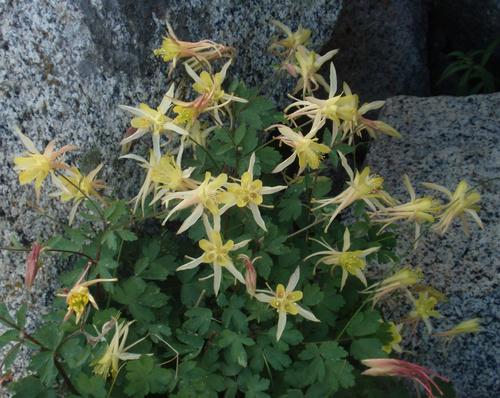
The Sierra Columbine (Aquilegia pubescens) is a stunning perennial wildflower endemic to the high-altitude rocky slopes of California's Sierra Nevada. Rising elegantly above alpine talus and rock crevices, this plant is a marvel of adaptation to harsh, cold environments. Its large, creamy-yellow to pastel-pink blossoms face upward toward the sky, which is a distinct departure from the downward-nodding habit of many other columbine species. It brings a delicate beauty to rugged granite landscapes, blooming during the brief alpine summer. Highly sought after by hikers and botanists alike, this species represents the fragile yet resilient nature of alpine flora.
Habitat: Found primarily in subalpine and alpine talus slopes, rocky crevices, and moist alpine meadows at elevations between 2,700 and 4,000 meters.
This plant features striking, cream-colored, pale yellow, or light pink flowers that measure about 3 to 5 cm across and face upward. Each blossom is characterized by five petal-like sepals and five true petals extending backward into long, slender nectar spurs that can reach up to 4 cm in length. The foliage consists of delicate, bluish-green, compound leaves divided into rounded leaflets, forming a basal clump from which the erect, sticky flower stems emerge, typically reaching heights of 20 to 60 cm.
Category
PlantsRarity
Common
Danger
1/5 · Very low
Snaps
Be the first to snap!
Contrary to the typical hanging posture of other columbines, the Sierra Columbine holds its flowers face-up, specifically adapted to entice hovering hawkmoths.
It thrives at extreme elevations, often found growing directly out of seemingly solid granite cracks up to 13,000 feet (4,000 meters) above sea level.
Where its range overlaps with the red Crimson Columbine, they hybridize to create a spectrum of beautiful cream, yellow, pink, and orange flowers.
Unlike nodding columbines, its flowers face skyward, making them highly visible to flying hawkmoths in open alpine environments.
Possesses exceptionally long spurs that hide nectar deep within, ensuring only specialized pollinators with long tongues can access it.
Features a low-growing basal rosette and deep root system that anchors the plant in rocky crevices, protecting it from fierce winds and freezing temperatures.
Generates its own energy through photosynthesis using sunlight, water, and carbon dioxide, while absorbing essential minerals from thin alpine soils.
Hyles lineata
The hawkmoth feeds on the nectar at twilight, transferring pollen between these high-altitude flowers.
Aquilegia formosa
Readily hybridizes with this species at transition zones between lower and higher elevations, producing intermediate pink-hued flowers.
Bombus vosnesenskii
Acts as a nectar robber by chewing holes in the bases of the long spurs to steal nectar without pollinating the flower.
No trait badges are assigned for this object yet.
No aliases listed yet.
Collections for this object will appear here as more themes are added.
Danger
1/5 · Very low
No special safety notes yet.
Start with the whole plant, then compare leaf arrangement, leaf edges, stems and any flowers or fruit. Opposite leaves grow in pairs; alternate leaves come one at a time along the stem. These details tell you far more together than a single green leaf does. Plant Identifier: upload a photo and compare the visible details.
20-60 cm
3-8 years
Generates its own energy through photosynthesis using sunlight, water, and carbon dioxide, while absorbing essential minerals from thin alpine soils.
Found primarily in subalpine and alpine talus slopes, rocky crevices, and moist alpine meadows at elevations between 2,700 and 4,000 meters.
Zoom in to split clusters and explore where this object has been snapped.
Recent snaps will appear here as new observations are added.
Take the discovery with you
Snap it with Snappit to identify it, learn what makes it special, and add the discovery to your collection.

















