


Silver Cholla
cylindropuntia echinocarpa
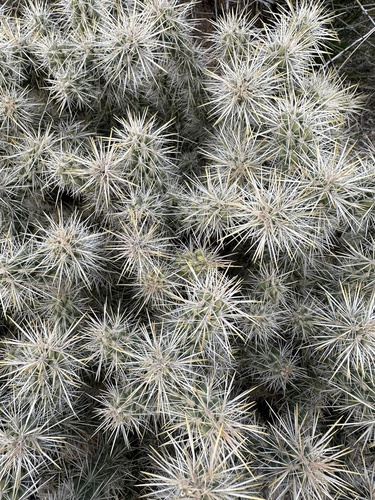
The Silver Cholla (Cylindropuntia echinocarpa) is a striking, highly branched cactus that reigns supreme in the arid lands of the southwestern United States and northwestern Mexico. Characterized by its dense armor of shimmering, golden-silver spines, this resilient desert survivor is a master of adaptation. It grows as an upright, highly branched shrub or small tree, casting a dramatic, glowing silhouette against the desert landscape when illuminated by the low sun. Beyond its prickly exterior, the Silver Cholla plays a critical role in its native ecosystem, providing impregnable nesting sites for desert birds and essential building materials for rodents seeking refuge from predators.
Habitat: Typically found on sandy, gravelly slopes, desert flats, and dry washes of the Mojave and Sonoran deserts.
This multi-branched cactus typically grows between 50 to 200 centimeters tall, exhibiting a shrubby or tree-like form with a short, woody trunk. Its cylindrical stem joints are light green, measuring 5 to 15 centimeters long, and are densely covered in formidable, sharp spines that range from silver-white to pale gold. Each spine is encased in a papery, reflective sheath. In late spring, it produces attractive, bell-shaped flowers that are greenish-yellow, occasionally tinged with bronze, which mature into dry, spiny, egg-shaped seed fruits.
Category
PlantsRarity
Common
Danger
1/5 · Very low
Snaps
Be the first to snap!
Native American groups like the Cahuilla traditionally harvested the flower buds, roasting them for hours to remove the spines and make a calcium-rich food.
The spines of the Silver Cholla have microscopic, backward-pointing barbs that pull deeper into flesh when touched, making extraction painful.
When backlit by the sun, the dense, golden-white papery sheaths surrounding the spines glow intensely, creating a beautiful 'halo' effect.
Stem segments detach easily upon contact, hitching rides on passing animals to root and propagate vegetatively elsewhere.
Dense, papery-sheathed spines reflect intense desert sunlight, significantly reducing the surface temperature of the plant.
Opens its stomata only at night to absorb carbon dioxide, dramatically reducing moisture loss during the scorching day.
Synthesizes its own energy from sunlight, water, and carbon dioxide using specialized desert-adapted photosynthesis.
Neotoma lepida
Uses the fallen, highly spiny joints of the Silver Cholla to build defensive walls around its nest entrances.

Campylorhynchus brunneicapillus
Builds its protected, dome-shaped nests deep within the thorny branches to keep chicks safe from predators.

Gopherus agassizii
Occasionally consumes the fallen flowers, fruits, and moisture-rich inner tissue of the cactus joints.
No trait badges are assigned for this object yet.
No aliases listed yet.
Collections for this object will appear here as more themes are added.
Danger
1/5 · Very low
No special safety notes yet.
Compare leaf arrangement, rosette shape, ribs, spines and flowers. Keep in mind that drought and strong sun can shift a plant's color and shape. Succulent Identifier: upload a photo and compare the visible details.
50-200 cm
5-50 kg
30-150 years
Synthesizes its own energy from sunlight, water, and carbon dioxide using specialized desert-adapted photosynthesis.
Typically found on sandy, gravelly slopes, desert flats, and dry washes of the Mojave and Sonoran deserts.
Zoom in to split clusters and explore where this object has been snapped.
Recent snaps will appear here as new observations are added.

Nevada, US
You might spot Creosote Bush, Brittlebush, and Beavertail Pricklypear.
View guide →

California, US
You might spot Western Joshua Tree and Engelmann's Hedgehog Cactus.
View guide →

California, US
You might spot Creosote Bush and Mojave Fringe-Toed Lizard.
View guide →

California, US
You might spot Red Rock Tarplant and Red Rock Canyon Monkeyflower.
View guide →

California, US
You might spot Black-Tailed Gnatcatcher and Brittlebush.
View guide →

California, US
You might spot Western Joshua Tree and Kingcup Cactus.
View guide →
Take the discovery with you
Snap it with Snappit to identify it, learn what makes it special, and add the discovery to your collection.

















