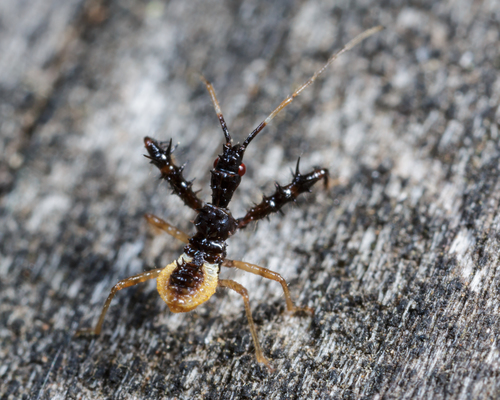


Sinea
sinea
Spined assassin bugs in the genus Sinea are remarkable and highly beneficial predators commonly found across North America. Easily recognized by their heavily armored, thorny appearance, these active hunters patrol gardens, fields, and forest edges in search of various agricultural pests. Utilizing a combination of patient ambush tactics and sudden strikes, they are vital components of natural pest control. Their stealthy, slow-moving nature makes them a fascinating subject for wildlife watchers and gardeners alike, who often spot them resting on sunny flower heads or stems.
Habitat: Found in open fields, gardens, shrublands, and agricultural crops, often perched on flowering plants.
Members of the genus Sinea typically range from 1 to 2.2 centimeters in length and exhibit dull brown, gray, or reddish-brown coloration, which helps them blend in with dried plant material. Their most distinctive feature is the array of sharp, prominent spines covering their head, pronotum, and particularly their enlarged, raptorial front legs. They possess a narrow, elongated head with a curved, needle-like beak tucked beneath it, large compound eyes, and wings that lie flat over their abdomen when at rest.
Category
InsectsRarity
Common
Danger
1/5 · Very low
Snaps
Be the first to snap!
Despite their small size, they can deliver a painful bite to humans if handled carelessly, which feels similar to a wasp sting.
During courtship, males use visual signals and abdominal vibrations to approach females cautiously to avoid being mistaken for prey.
Their front legs are coated in fine hairs and spines that generate high friction, making it almost impossible for slick or glossy beetles to escape.
Armed with heavily spined front legs that can securely clamp down on struggling prey, preventing escape.
Injects a potent cocktail of paralyzing venom and digestive enzymes to quickly liquefy the internal tissues of its prey.
Stands motionless with its front legs raised, mimicking a harmless dry twig to deceive both unsuspecting prey and potential predators.
A strict predator of other arthropods, consuming a wide variety of crop pests and soft-bodied insects.
Lygus lineolaris
Actively hunts and consumes tarnished plant bugs on vegetable crops.
Aphis gossypii
Preys heavily on pest infestations of cotton aphids in gardens and fields.
Peucetia viridans
Is hunted and eaten by large predatory garden spiders in overlapping shrub habitats.
No trait badges are assigned for this object yet.
No aliases listed yet.
Collections for this object will appear here as more themes are added.
Danger
1/5 · Very low
No special safety notes yet.
Look for six legs, antennae, three body sections and the shape of the wings. Beetles have hardened front wings; flies have just one working pair. Tiny insects may need a close view before their group is clear. Insect Identifier: upload a photo and compare the visible details.
2 km/h
A strict predator of other arthropods, consuming a wide variety of crop pests and soft-bodied insects.
Found in open fields, gardens, shrublands, and agricultural crops, often perched on flowering plants.
Ambush2025 01 20t21:40:00z 05:00 Bug Predator Tactic Ambush And Stalking Technique Which Combines Stealth With Swift Striking Capability Using Front Legs To Ensnare Unsuspecting Prey Objects Passing Nearby Plant Foliage Or Flowers Where It Waits Patiently For Long Stretches Of Time During Sunlit Hours Of Daytime Activity Patterns Exhibiting High Levels Of Efficient Pest Control In Managed And Natural Ecosystems Alike And Beneficial To Farmers And Gardeners Who Rely On Such Beneficial Predators To Keep Insect Populations Under Control Without Chemical Intervention Or Excessive Crop Damage From Herbivorous Invaders Of All Shapes And Sizes Including Pest Species Like Aphids And Harmful Beetles That Often Infest Agricultural Landscapes And Cultivated Gardens Across Various Regions Of North America Where This Genus Of Assassin Bugs Is Most Prevalent And Highly Valued For Its Natural Insecticidal Properties And Ecological Balance Maintenance Functions Which Support Healthy Plant Growth And Biodiversity Preservation Efforts Locally And Regionally Throughout Its Distribution Range While Remaining Largely Harmless To Humans Unless Handled Carelessly Or Provoked Resulting In A Painful But Otherwise Medically Insignificant Bite That Can Cause Temporary Discomfort And Swelling At The Site Of The Wound But No Serious Health Issues For Most Individuals Making Them Mostly Safe To Observe From A Distance And Enjoy Their Fascinating Behaviors And Intricate Anatomy Which Reflects Their Highly Specialized Role As Apex Micro Predators In The Undergrowth And On The Petals Of Blooming Flowers Where Life And Death Struggles Unfold Constantly Below Our Normal Field Of Vision And Remind Us Of The Complexity And Interconnectedness Of Nature All Around Us Even In Highly Urbanized Settings Or Man Made Habitats Where These Resilient And Adaptable Insects Continue To Thrive And Perform Their Vital Ecological Duties Day In And Day Out During The Warmer Months Of The Year When They Are Most Active And Easily Spotted By Observant Nature Enthusiasts And Scientists Alike Seeking To Understand The Delicate Balance Of Our Shared Environment And The Many Species That Contribute To It In Their Own Unique And Specialized Ways As Exemplified By The Amazing Genus Sinea And Its Spiny Members
Zoom in to split clusters and explore where this object has been snapped.
Recent snaps will appear here as new observations are added.
Take the discovery with you
Snap it with Snappit to identify it, learn what makes it special, and add the discovery to your collection.