
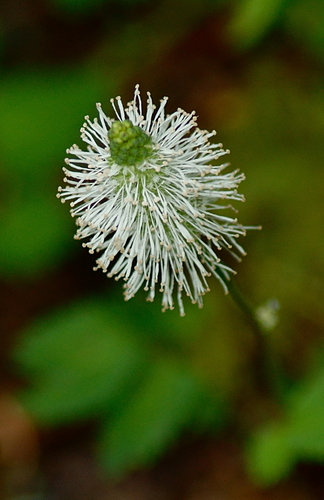


Sitka Burnet
sanguisorba stipulata
The Sitka Burnet is a striking perennial herb native to the damp, cool regions of western North America and northeastern Asia. Growing from a thick, woody rhizome, this member of the rose family stands out in subalpine meadows and boggy areas with its elegant, compound leaves and distinctive fluffy flower spikes. Its scientific name, Sanguisorba stipulata, highlights its prominent leaf-like stipules, which set it apart from closely related species in the wild.
Habitat: Thrives in wet meadows, bogs, stream banks, and damp subalpine slopes of western North America and northeastern Asia.
This upright perennial typically reaches heights of 30 to 100 centimeters. It features pinnately compound leaves with coarsely tooth-edged leaflets and conspicuous leaf-like stipules at the base of the leaf stalks. The most striking visual identifier is its tight, cylindrical terminal flower spike, measuring 2 to 8 centimeters long. The individual flowers lack petals entirely, instead boasting long, white, protruding stamens that give the entire flower head a soft, fuzzy, bottle-brush-like appearance.
Category
PlantsRarity
Common
Danger
1/5 · Very low
Snaps
Be the first to snap!
The genus name Sanguisorba translates to 'blood-absorber,' a reference to the historical use of related burnet species in traditional herbal medicine to staunch wounds and bleeding.
The specific epithet 'stipulata' refers to the unusually large, leafy ear-like structures called stipules found at the base of its leaf stems.
Unlike most of its showy relatives in the Rosaceae (rose) family, the Sitka Burnet's flowers contain zero petals.
Possesses a robust, thick rhizome system that allows the plant to survive and resprout in waterlogged, low-oxygen soils typical of wetlands and bogs.
Compensates for its complete lack of petals by growing elongated, bright white stamens that visually mimic petals to attract generalist insect pollinators.
Utilizes unusually large, leafy stipules at the stem junctions to maximize light absorption in dense, competitive subalpine plant communities.
As a photosynthetic plant, the Sitka Burnet converts sunlight, carbon dioxide, and water into sugars, drawing vital minerals through its deep rhizomes.

Ursus arctos
The roots and early spring shoots provide nutrient-rich forage for foraging bears.
Megachile spp.
The long, white, pollen-rich stamens are a vital food source for native pollinating bees.

Pyrgus centaureae
Larvae feed on the compound leaves of Sanguisorba as their primary host plant.
No trait badges are assigned for this object yet.
No aliases listed yet.
Collections for this object will appear here as more themes are added.
Danger
1/5 · Very low
No special safety notes yet.
Start with the whole plant, then compare leaf arrangement, leaf edges, stems and any flowers or fruit. Opposite leaves grow in pairs; alternate leaves come one at a time along the stem. These details tell you far more together than a single green leaf does. Plant Identifier: upload a photo and compare the visible details.
30-100 cm
5-15 years
As a photosynthetic plant, the Sitka Burnet converts sunlight, carbon dioxide, and water into sugars, drawing vital minerals through its deep rhizomes.
Thrives in wet meadows, bogs, stream banks, and damp subalpine slopes of western North America and northeastern Asia.
Zoom in to split clusters and explore where this object has been snapped.
Recent snaps will appear here as new observations are added.
Take the discovery with you
Snap it with Snappit to identify it, learn what makes it special, and add the discovery to your collection.

















