
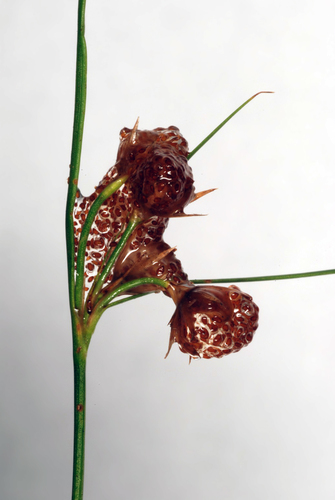


Slender Path Rush
juncus tenuis
Slender Path Rush (Juncus tenuis) is a highly resilient, perennial rush that thrives where few other plants can survive. Often mistaken for a common grass, this remarkable plant is uniquely adapted to compacted soils, frequently lining hiking trails, forest pathways, and dirt roads. Its ability to withstand heavy foot traffic and soil compaction has earned it its common name and made it a ubiquitous presence across North America and beyond, where it has naturalized globally. Instead of being crushed by trampling, this species relies on humans and animals to help disperse its seeds. Its tiny seeds develop a sticky mucilage layer when wet, allowing them to cling to boots, paws, and tires, successfully colonizing new pathways.
Habitat: Found primarily on compacted soils along hiking trails, dirt paths, park lawns, and roadsides, often in both full sun and partial shade.
This plant forms dense, tufted clumps of wiry, yellowish-green to dark green stems reaching 15 to 60 cm in height. The stems are round, unbranched, and smooth, emerging from a shallow root system. At the top of each stem, a branched, terminal flower cluster appears, featuring tiny, six-parted greenish-brown flowers. A key identifying feature is the presence of two or three long, leaf-like bracts that extend well past the flower cluster, framing the inflorescence in an elegant, disheveled crown.
Category
PlantsRarity
Common
Danger
1/5 · Very low
Snaps
Be the first to snap!
It is nicknamed the 'Poverty Rush' because it frequently grows on dry, nutrient-poor, compacted soil where crops and grass fail to grow.
Its tough, wiry stems were historically used by children to weave small baskets and mats, or tied together to make temporary cordage.
The seeds of this plant become highly sticky when wet, acting like natural Velcro to hitchhike on hiking boots and animal paws.
The plant possesses extremely tough, fibrous stems and leaves that tolerate extreme compaction and direct foot traffic without breaking.
When wet, the seeds produce a sticky, gelatinous coat that easily adheres to passing animals, shoes, and vehicle tires.
Its roots are specialized to penetrate and absorb oxygen from dense, clay-heavy, and heavily packed soils where other plants suffocate.
As a photoautotroph, the Slender Path Rush produces its own food through photosynthesis using sunlight, water, and carbon dioxide.
Coleophora caespititiella
The caterpillar of this moth species feeds on the developing seeds of Juncus species.

Odocoileus virginianus
White-tailed deer occasionally graze on the foliage of this rush when other food is scarce, though it is low-preference.

Lasioglossum species
Solitary bees visit the small flowers for pollen, assisting in pollination.
No trait badges are assigned for this object yet.
No aliases listed yet.
Collections for this object will appear here as more themes are added.
Danger
1/5 · Very low
No special safety notes yet.
Compare seed heads, stem shape, how leaves attach, and the joint where leaf meets stem. A patch of mown lawn rarely shows enough for an exact ID. Grass Identifier: upload a photo and compare the visible details.
15-60 cm
2-10 years
As a photoautotroph, the Slender Path Rush produces its own food through photosynthesis using sunlight, water, and carbon dioxide.
Found primarily on compacted soils along hiking trails, dirt paths, park lawns, and roadsides, often in both full sun and partial shade.
Zoom in to split clusters and explore where this object has been snapped.
Recent snaps will appear here as new observations are added.
Take the discovery with you
Snap it with Snappit to identify it, learn what makes it special, and add the discovery to your collection.


















