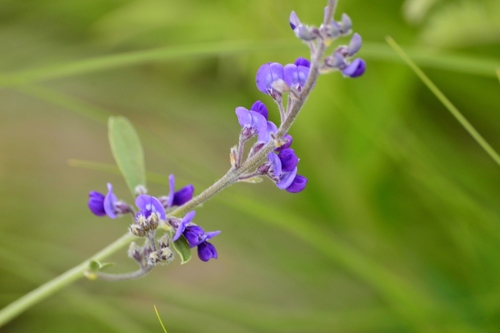


Slimflower Scurfpea
pediomelum tenuiflorum
The Slimflower Scurfpea is an elegant, multi-branched perennial herb native to the vast grasslands of North America's Great Plains. Belonging to the legume family, this plant is characterized by its slender, airy structure and tough, wiry stems. Although it looks delicate, it is a remarkably hardy survivor, perfectly adapted to withstand the scorching heat, drought, and high winds of the open prairie. Its deep taproot anchors it firmly in sandy or rocky soils where other plants might wither. Historically, this species played an important role in the prairie ecosystem and was utilized by various Indigenous peoples for medicinal purposes and food. Today, it remains a vital component of native grasslands, providing food for specialized insects and stabilizing soil with its deep root system. Its unassuming beauty and ecological resilience make it a beloved find for prairie enthusiasts and botanists alike.
Habitat: Found in undisturbed prairies, open grasslands, sandy hillsides, and rocky upland woods.
Slimflower Scurfpea grows as a highly branched, bushy herb standing between 30 and 100 centimeters tall. It features slender, grayish-green stems that are covered in fine, pressed hairs and dotted with tiny, dark, translucent glands. The leaves are palmately compound, typically split into three to five narrow, linear leaflets. From May to September, it produces loose, elongated clusters of very small, pea-like flowers, which are light blue to pale purple and measure only about 5 millimeters in length.
Category
PlantsRarity
Common
Danger
1/5 · Very low
Snaps
2
Indigenous tribes such as the Lakota historically used the tough, stringy roots of this plant to construct strong, rustic cordage.
The plant's scientific name 'tenuiflorum' translates directly to 'thin-flowered', referring to its exceptionally delicate, sparse blossoms.
The tiny glands dotted over its leaves look like black or brown pepper spots under a magnifying glass and release a faint, herbaceous aroma when bruised.
Develops a deep, sturdy taproot that penetrates far into the dry prairie soil to access deep-water reserves.
In late autumn, the dry stem cleanly snaps at ground level, letting the wind roll the plant like a tumbleweed to scatter its seeds across the landscape.
Features hundreds of tiny, resinous glands on its leaves and stems that secrete oils to deter herbivores and reduce water loss.
As a photoautotrophic plant, it produces its own energy through photosynthesis, utilizing sunlight, water, carbon dioxide, and soil nutrients.
.jpg&width=800)
Colias philodice
The caterpillars of this butterfly species feed on the leaves of the slimflower scurfpea.
Bombus pensylvanicus
An important native pollinator that visits the tiny flowers for nectar and pollen.
No trait badges are assigned for this object yet.
No aliases listed yet.
Collections for this object will appear here as more themes are added.
Danger
1/5 · Very low
No special safety notes yet.
The easiest way to identify Slimflower Scurfpea is to use the Snappit nature identifier app.
30-100 cm
0.05-0.2 kg
3-10 years
As a photoautotrophic plant, it produces its own energy through photosynthesis, utilizing sunlight, water, carbon dioxide, and soil nutrients.
Found in undisturbed prairies, open grasslands, sandy hillsides, and rocky upland woods.
Zoom in to split clusters and explore where this object has been snapped.
Take the discovery with you
Snap it with Snappit to identify it, learn what makes it special, and add the discovery to your collection.












.jpg&width=800)



_001.jpg&width=800)




