.jpg&width=800)





Clouded Sulphur
Colias philodice
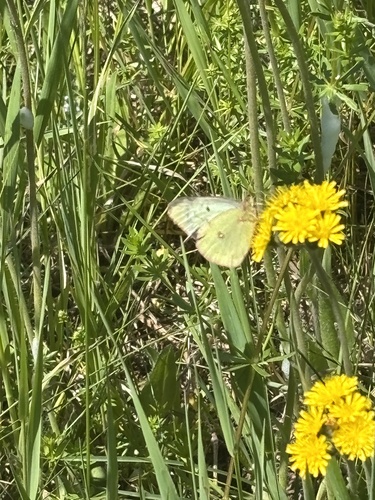
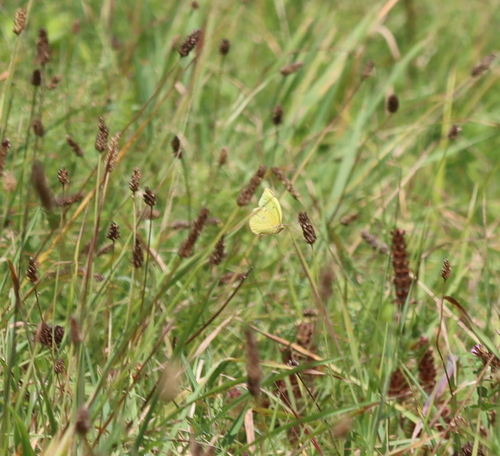
The Clouded Sulphur is a bright yellow butterfly with beautiful orange spots. It flutters around fields and gardens, bringing joy to everyone who sees it!
Habitat: Fields and gardens
The Clouded Sulphur is a medium-sized butterfly, usually bright yellow in males and paler yellow or white in females. Its wings have a distinct black border, often broader on the forewings, and a small black spot on each forewing, helping to distinguish it from similar sulphur butterflies.
Category
InsectsRarity
Common
Danger
1/5 · Very low
Snaps
10
Clouded Sulphur caterpillars are camouflaged green, blending perfectly with plant leaves!
Many Clouded Sulphurs gather at puddles to sip water and important minerals!
Some female Clouded Sulphurs are pure white, a cool trick called the 'alba' form!
These butterflies drink flower nectar using a long, straw-like 'proboscis'!
Clouded Sulphur has wing colors that can appear brighter or duller, helping them absorb sunlight or blend into their surroundings.
Clouded Sulphur can fly rapidly and erratically, making it difficult for predators to catch them mid-air.
Clouded Sulphur can complete several life cycles in a single warm season, allowing their populations to grow quickly.
Adults sip nectar; caterpillars munch on legume leaves.
Age differences: Larvae eat leaves, while adults drink nectar from flowers.
Marked with spots or patches of a different color.
Social animals live in organized groups, cooperating for survival benefits such as foraging, defense, and raising offspring.
Colorful describes organisms or objects displaying a wide range of bright and distinct colors.
Grassland habitats are terrestrial biomes dominated by grasses and herbaceous plants, supporting a variety of grazing animals.

This trait characterizes organisms whose diet consists entirely or primarily of plant material.

Describes plants that are particularly attractive and beneficial to a wide range of pollinating organisms.

Diurnal animals are primarily active during daylight hours, typically resting or sleeping at night.

This habitat trait indicates species that can coexist with humans in urban and suburban environments, utilizing man-made structures and green spaces.

Describes organisms that transfer pollen, enabling the fertilization and reproduction of plants.
Danger
1/5 · Very low
Always watch butterflies from a distance so they feel safe and can fly freely.
The easiest way to identify Clouded Sulphur is to use the Snappit nature identifier app.
35-60 mm
17-25 mm
7-14 days
20 km/h
Adults sip nectar; caterpillars munch on legume leaves.
Fields and gardens
Foraging
Zoom in to split clusters and explore where this object has been snapped.
Jun 4, 2026
Brattleboro Downtown Historic DistrictPhoto attribution
(c) kevinhemeon, some rights reserved (CC BY)
License: CC BY 4.0 ↗
Image may be shown cropped inside the card frame.
Aug 29, 2025
Lower Village DistrictPhoto attribution
(c) Steven Lamonde, some rights reserved (CC BY)
License: CC BY 4.0 ↗
Image may be shown cropped inside the card frame.

District of Columbia, US
You might spot Eastern Gray Squirrel, Duck, and House Sparrow.
View guide →

Vermont, US
You might spot Asian Bittersweet, Alder Buckthorn, and Eastern Newt.
View guide →

Maine, US
You might spot Pink Lady's Slipper, Wood Lily, and Great Blue Heron.
View guide →

Virginia, US
You might spot Osage-Orange, Purple Finch, and Turkey.
View guide →

Montana, US
You might spot Bighorn Sheep and Curlleaf Mountain Mahogany.
View guide →

Kansas, US
You might spot Panthera Pardus Orientalis, Snow Leopard, and African Lion.
View guide →
Take the discovery with you
Snap it with Snappit to identify it, learn what makes it special, and add the discovery to your collection.








.jpg&width=800)



