





small-flowered blue-eyed mary
Collinsia parviflora
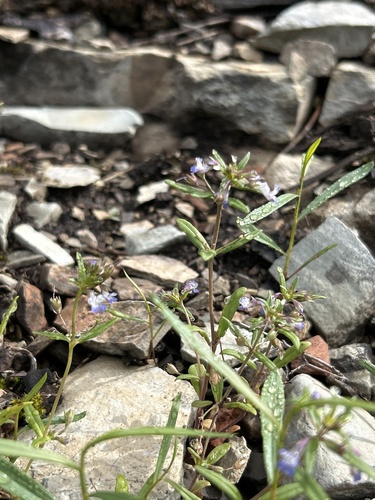
The small-flowered blue-eyed mary is a pretty little flower with tiny blue and white blooms. It often grows in clusters and can be found in many places, bringing beauty to gardens and fields.
Habitat: Grasslands
The small-flowered blue-eyed mary is a slender annual herb with delicate, two-lipped flowers typically a vibrant blue or violet, often featuring white or yellow markings on the lower lip. Its small size and bright blooms help it stand out in early spring.
Category
PlantsRarity
Common
Danger
1/5 · Very low
Snaps
5
It's an "ephemeral" beauty, meaning its brief bloom delights only for a short time!
Its tiny flowers are perfect landing pads for small, busy native bees.
Named after botanist Thomas Nuttall, who first described it in North America.
Some species of blue-eyed mary are native only to California, nowhere else!
This plant can grow, flower, and set seeds rapidly, completing its entire life cycle in just a few weeks after rain.
Small-flowered blue-eyed mary produces many tiny seeds that can be easily dispersed by wind or water to new locations.
Apis mellifera
Visits flowers for nectar and pollen.
Bombus vosnesenskii
An important native pollinator in its range.
Myzus persicae
Sap-feeding insect that can feed on many plants.
Flowering plants are any plants that produce flowers as part of their reproductive cycle.
Ornamental plants are cultivated primarily for their aesthetic appeal, enhancing landscapes and gardens with their attractive foliage, flowers, or form.
Cluster flowers are inflorescences where individual flowers are arranged closely together on a common stem.
Spring blooming plants produce their flowers during the spring season, often signifying the end of winter and the start of new growth.

Colorful describes organisms or objects displaying a wide range of bright and distinct colors.

Grassland habitats are terrestrial biomes dominated by grasses and herbaceous plants, supporting a variety of grazing animals.

Describes plants that are particularly attractive and beneficial to a wide range of pollinating organisms.
No aliases listed yet.
Danger
1/5 · Very low
Always look but don't pick flowers, so everyone can enjoy them!
The easiest way to identify small-flowered blue-eyed mary is to use the Snappit nature identifier app.
5-40 cm
5-15 cm
0.3-1 cm
Spring to early summer
No
None
Annual
Zoom in to split clusters and explore where this object has been snapped.
May 30, 2026
Great Northern Railway BuildingsPhoto attribution
(c) Taryn Brahmsteadt, some rights reserved (CC BY)
License: CC BY 4.0 ↗
Image may be shown cropped inside the card frame.

Montana, US
You might spot Bighorn Sheep and Mountain Goat.
View guide →
Nevada, US
You might spot African Lion, Tiger, and Zebra.
View guide →

Idaho, US
You might spot Limber Pine and Dwarf Purple Monkeyflower.
View guide →

Wyoming, US
You might spot Moose and Yellow-Bellied Marmot.
View guide →

Wyoming, US
You might spot Moose and Yellow-Bellied Marmot.
View guide →

Nevada, US
You might spot Great Basin Bristlecone Pine and Holmgren's Buckwheat.
View guide →
Take the discovery with you
Snap it with Snappit to identify it, learn what makes it special, and add the discovery to your collection.







.jpg&width=800)



_001.jpg&width=800)




