_(4732404596).jpg&width=800)





Ivy-leaved toadflax
Cymbalaria muralis
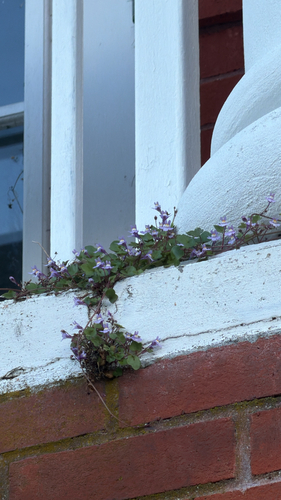
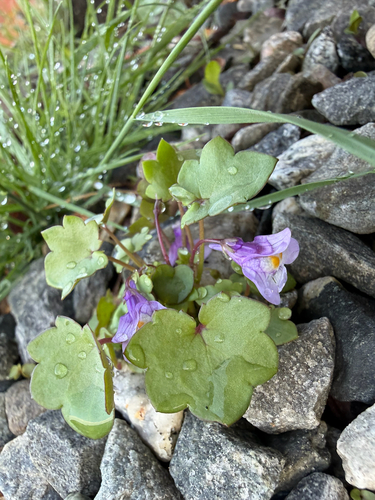
Ivy-leaved toadflax is a pretty plant with small purple flowers that look like tiny butterflies! It often grows in cracks of walls and rocks, making it a special friend of old buildings.
Habitat: Urban areas
The Ivy-leaved toadflax has trailing stems adorned with small, kidney-shaped leaves resembling miniature ivy. Its delicate, snapdragon-like flowers are a charming blend of purplish-blue or lilac with a bright yellow throat. This plant often forms cascading mats, especially in rocky crevices.
Category
PlantsRarity
Common
Danger
1/5 · Very low
Snaps
18
Its leaves change shape a little depending on how much sun they get!
Its tiny snapdragon-like flowers are a mix of vibrant purple and yellow!
Some people call it 'Mother of Thousands' because it spreads so easily!
This little plant is a master at growing right out of stone walls!
Ivy-leaved toadflax can strategically bend its flower stalks after blooming, pushing seeds into dark, protective rock crevices to germinate safely.
Ivy-leaved toadflax thrives in rocky crevices, using specialized roots to anchor firmly into tiny gaps and absorb essential moisture.
It reproduces easily by seeds and stems rooting where they touch the ground, allowing it to quickly colonize new areas.
Apis mellifera
collects nectar from its small flowers.
Bombus terrestris
helps transfer pollen between blooms.
Arion lusitanicus
occasionally grazes on its tender leaves.
Flowering plants are any plants that produce flowers as part of their reproductive cycle.
Summer blooming plants produce their flowers during the summer season, often providing vibrant color when many other plants have finished.
Everblooming plants produce flowers continuously or in repeated flushes over a long period.
Colorful describes organisms or objects displaying a wide range of bright and distinct colors.

Describes plants that are particularly attractive and beneficial to a wide range of pollinating organisms.

This habitat trait indicates species that can coexist with humans in urban and suburban environments, utilizing man-made structures and green spaces.

Describes organisms that transfer pollen, enabling the fertilization and reproduction of plants.
No aliases listed yet.
Danger
1/5 · Very low
Always look but don't touch plants without asking an adult first.
The easiest way to identify Ivy-leaved toadflax is to use the Snappit nature identifier app.
5-15 cm
30-100 cm
0.5-1.5 cm
Spring_to_fall
Yes
None
Perennial
Zoom in to split clusters and explore where this object has been snapped.
May 14, 2026
Bean Hill Historic DistrictPhoto attribution
(c) Sawyer Baran, some rights reserved (CC BY)
License: CC BY 4.0 ↗
Image may be shown cropped inside the card frame.
May 14, 2026
Bean Hill Historic DistrictPhoto attribution
(c) Sawyer Baran, some rights reserved (CC BY)
License: CC BY 4.0 ↗
Image may be shown cropped inside the card frame.

Connecticut, US
You might spot Striped Wintergreen and Common Eastern Bumble Bee.
View guide →

Rhode Island, US
You might spot Rugosa Rose and American Herring Gull.
View guide →

US
You might spot Rugosa Rose and American Herring Gull.
View guide →

Washington, US
You might spot Rock Pigeon, American Crow, and Olympic Gull.
View guide →

West Virginia, US
You might spot Virginia Bluebells, Bloodroot, and Maidenhair Spleenwort.
View guide →
.jpg)
Municipal District of Cobh, IE
You might spot Ring-Tailed Lemur, Giraffes, and Cheetahs.
View guide →
Take the discovery with you
Snap it with Snappit to identify it, learn what makes it special, and add the discovery to your collection.








.jpg&width=800)



_001.jpg&width=800)




