
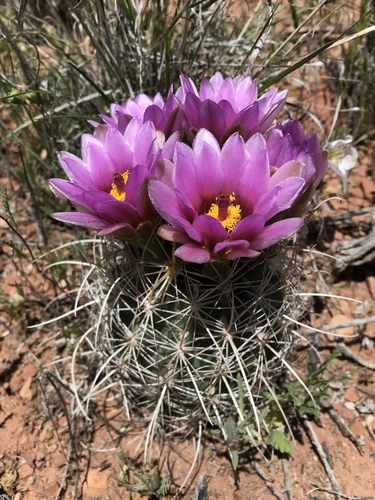


Smallflower Fishhook Cactus
sclerocactus parviflorus
The Smallflower Fishhook Cactus (Sclerocactus parviflorus) is a hardy, captivating desert survivor native to the high deserts of the southwestern United States, particularly the Colorado Plateau. This small, cylindrical cactus has evolved remarkable defenses and water-saving strategies to thrive in incredibly harsh, arid landscapes where few other plants can survive. Often growing solitary, it serves as a critical micro-habitat and food source for local pollinators and desert wildlife. During the late spring, this unassuming plant undergoes a stunning transformation, bursting into vivid pink, magenta, or occasionally yellow blossoms that crown its spiny head. Its resilience and unique architecture make it a highly sought-after sight for desert hikers and native plant enthusiasts alike, epitomizing the rugged beauty of the American West.
Habitat: Typically found on rocky clay hills, gravelly slopes, and sandstone outcroppings within desert shrublands and piñon-juniper woodlands.
This small cactus typically features a single, egg-shaped to cylindrical stem that grows 10 to 45 centimeters tall and 5 to 11 centimeters in diameter. It is distinguished by its 13 to 15 spiraling ribs covered in dense clusters of spines. Each cluster contains several straight, light-colored radial spines and 1 to 4 prominent central spines, at least one of which is strongly hooked, reddish-brown to dark gray, and projects outward like a fishhook. In spring, it produces funnel-shaped flowers, measuring about 3 to 5 centimeters across, varying from bright lavender-pink to rose-purple, followed by small, scaly green-to-reddish fruits.
Category
PlantsRarity
Common
Danger
1/5 · Very low
Snaps
Be the first to snap!
Its seeds have a dormant period and often require a cold stratification winter period before they can successfully germinate in the spring.
The common name 'fishhook' refers to the sharp, curved central spines which look exactly like fishing tackle and can easily snag skin or clothing.
This cactus can survive extreme cold temperatures down to -20 degrees Celsius, a necessary adaptation for the high-altitude deserts of the Colorado Plateau.
The fishhook-shaped central spines act as a formidable physical deterrent against herbivores and help catch debris for additional shade.
Performs CAM photosynthesis, keeping its stomata closed during the scorching day and opening them at night to absorb carbon dioxide while minimizing water loss.
Possesses specialized roots that contract during dry seasons, pulling the body of the cactus closer to or even slightly beneath the soil surface for protection.
As a photosynthetic plant, it manufactures its own sugars using sunlight, carbon dioxide, and water while extracting essential minerals from rocky soils.
Lithurgopsis apicalis
Pollinates the flowers while gathering nectar and pollen during the spring blooming season.
Neotoma lepida
Consumes the juicy flesh and seeds of the cactus during dry periods, navigating around the sharp spines.

Artemisia tridentata
Competes for limited soil moisture, space, and nutrients in the arid desert environment.
No trait badges are assigned for this object yet.
No aliases listed yet.
Collections for this object will appear here as more themes are added.
Danger
1/5 · Very low
No special safety notes yet.
Compare leaf arrangement, rosette shape, ribs, spines and flowers. Keep in mind that drought and strong sun can shift a plant's color and shape. Succulent Identifier: upload a photo and compare the visible details.
10+ cm
0.2+ kg
20+ years
As a photosynthetic plant, it manufactures its own sugars using sunlight, carbon dioxide, and water while extracting essential minerals from rocky soils.
Typically found on rocky clay hills, gravelly slopes, and sandstone outcroppings within desert shrublands and piñon-juniper woodlands.
Zoom in to split clusters and explore where this object has been snapped.
Recent snaps will appear here as new observations are added.
Take the discovery with you
Snap it with Snappit to identify it, learn what makes it special, and add the discovery to your collection.


















