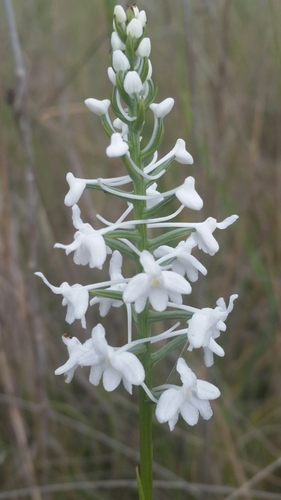


Snowy Orchid
platanthera nivea
The Snowy Orchid (Platanthera nivea) is a strikingly beautiful and delicate terrestrial orchid native to the southeastern United States. Renowned for its pristine white flowers, this species stands out amidst the often-lush greenery of its wetland habitats. Its survival is intricately linked to specific environmental conditions and symbiotic relationships, making it a sensitive indicator of ecosystem health. The orchid's understated elegance and specialized life cycle fascinate botanists and nature enthusiasts alike, highlighting the complex interdependencies within bog and fen communities.
Habitat: Found in nutrient-poor, acidic wetland environments such as bogs, fens, wet pine flatwoods, and savannas.
The Snowy Orchid features a slender, erect stem typically ranging from 20 to 70 cm in height, bearing a terminal raceme of numerous pure white flowers. Each flower possesses a delicate, three-lobed lip and a distinct spur. The petals and sepals are also white, creating a uniform, ethereal appearance. Basal leaves are linear to lance-shaped, often appearing early in the season and sometimes withering before the plant blooms. The overall impression is one of stark beauty and purity against its often dark, wet surroundings.
Category
PlantsRarity
Common
Danger
1/5 · Very low
Snaps
Be the first to snap!
Its pure white flowers are thought to reflect moonlight, making them highly visible to nocturnal pollinators like moths in its dimly lit wetland habitat.
Like many orchids, the Snowy Orchid's seeds are microscopic and lack stored food, requiring a specific mycorrhizal fungus to provide nutrients for germination and early growth.
The genus name 'Platanthera' is derived from Greek words meaning 'flat' and 'anther', referring to the broad, flat anthers characteristic of these orchids.
This orchid often grows alongside carnivorous plants such as pitcher plants and sundews, sharing the same nutrient-poor, acidic bog and fen ecosystems.
Like most orchids, Platanthera nivea relies on a symbiotic relationship with mycorrhizal fungi for germination and nutrient absorption, especially during its early, non-photosynthetic stages of life.
Its pure white flowers, often faintly fragrant at night, are adapted to attract nocturnal pollinators, typically hawkmoths or other specific moths, which are guided by the flower's luminescence in low light.
This orchid is highly adapted to thrive in waterlogged, acidic soils with low nutrient availability, a challenging environment where few other flowering plants can persist.
The Snowy Orchid primarily produces its own food through photosynthesis, utilizing sunlight, carbon dioxide, and water. However, it forms a crucial symbiotic relationship with mycorrhizal fungi for essential nutrient uptake, particularly during its seedling stage and in nutrient-poor soils.
Age differences: Seedlings are entirely dependent on mycorrhizal fungi for nutrients until they develop sufficient photosynthetic capabilities. Mature plants continue to rely on this fungal partnership to supplement nutrient acquisition.
Tulasnella spp.
Essential for seed germination and nutrient uptake throughout the orchid's life cycle, especially in nutrient-poor environments.
Hyles lineata
Primary pollinator, attracted to the orchid's white flowers and potential nocturnal fragrance, transferring pollen between individuals.
Sarracenia flava
Often shares the same acidic, nutrient-poor wetland habitats, indicating similar ecological requirements.
Drosera capillaris
Co-occurs in boggy environments, both thriving in the acidic, moist conditions of the shared habitat.
No trait badges are assigned for this object yet.
No aliases listed yet.
Collections for this object will appear here as more themes are added.
Danger
1/5 · Very low
No special safety notes yet.
Start with the whole plant, then compare leaf arrangement, leaf edges, stems and any flowers or fruit. Opposite leaves grow in pairs; alternate leaves come one at a time along the stem. These details tell you far more together than a single green leaf does. Plant Identifier: upload a photo and compare the visible details.
20-70 cm
0.01-0.05 kg
5-15 years
The Snowy Orchid primarily produces its own food through photosynthesis, utilizing sunlight, carbon dioxide, and water. However, it forms a crucial symbiotic relationship with mycorrhizal fungi for essential nutrient uptake, particularly during its seedling stage and in nutrient-poor soils.
Found in nutrient-poor, acidic wetland environments such as bogs, fens, wet pine flatwoods, and savannas.
Zoom in to split clusters and explore where this object has been snapped.
Recent snaps will appear here as new observations are added.
Take the discovery with you
Snap it with Snappit to identify it, learn what makes it special, and add the discovery to your collection.