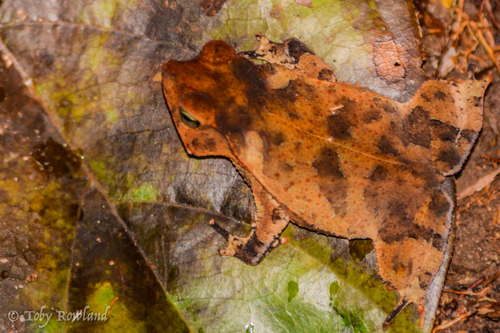


South American Common Toad
rhinella margaritifera
The South American Common Toad (Rhinella margaritifera), also known as the crested leaf toad, is a master of disguise native to the vast tropical forests of South America. As a member of a broader "species complex," this toad represents an evolutionary marvel of camouflage, blending seamlessly into the forest floor. By perfectly imitating a dead, decaying leaf—complete with dorsal ridges that beautifully mimic midveins and stems—it avoids detection by passing predators and unsuspecting prey alike. Its presence is a strong indicator of a healthy, robust leaf litter ecosystem within primary and secondary rainforests. Encountering one in the wild requires a keen, patient eye, as the toad relies almost entirely on staying perfectly still, springing into action only to snatch up a passing insect or to make a short, hopping escape when directly threatened. Biologists continue to study these intriguing amphibians to unravel the deep genetic mysteries of their sprawling, highly diverse populations.
Habitat: Typically found dwelling among the dense leaf litter on the floor of humid tropical lowland and lower montane rainforests.
This toad is visually defined by its extraordinary cryptic morphology, characterized by a flattened, angular body and highly variable coloration in shades of brown, gray, yellow, and deep red. A distinct, raised dorsal line runs down its back, mimicking the midvein of a decaying leaf, while prominent bony crests above the eyes and a pointed snout enhance the illusion of a leaf's stem and edges. Its parotoid glands are relatively small but visible behind the cranial crests. Measuring between 5 and 9 centimeters in length, its limbs are relatively short and are tucked tightly against the body when resting to eliminate recognizable shadows.
Category
AmphibiansRarity
Common
Danger
1/5 · Very low
Snaps
Be the first to snap!
Its camouflage is so exact that even the shadow of the toad is hidden; it presses its belly firmly to the ground to avoid casting a telltale frog silhouette.
Scientists classify Rhinella margaritifera as a 'species complex,' meaning this single scientific name likely covers several genetically distinct but nearly identical looking toad species.
Unlike frogs that rely on powerful hind legs for long leaps to escape predators, this toad relies almost entirely on staying perfectly motionless, trusting its disguise over its speed.
The toad's body shape, distinct coloration, and dorsal ridges perfectly imitate a decaying leaf, hiding it in plain sight on the forest floor.
Like most toads, it possesses glands behind its eyes that secrete mildly toxic bufotoxins to sicken and deter predators when ingested.
When startled, the toad flattens its body firmly against the ground and tucks its limbs, remaining motionless to eliminate shadows and complete its leaf disguise.
The South American Common Toad relies on its exquisite camouflage to ambush small invertebrates that wander too close to it on the forest floor.
Age differences: Tadpoles are largely herbivorous and detritivorous, feeding on algae and decaying organic matter in temporary forest pools.
Oxybelis aeneus
Vine snakes often actively hunt these well-camouflaged toads in the dense leaf litter.
Atta cephalotes
These toads feed heavily on abundant forest-floor insects, including various species of leaf-cutter ants.

Rhinella marina
Shares habitat and competes for invertebrate prey with the juveniles of the much larger cane toad.
No trait badges are assigned for this object yet.
Collections for this object will appear here as more themes are added.
Danger
1/5 · Very low
No special safety notes yet.
Check the toe pads, leg length, eye markings, back pattern and body shape. Don't lean on color: some frogs change shade to match their surroundings. Frog Identifier: upload a photo and compare the visible details.
5-9 cm
0.02-0.05 kg
4-8 years
The South American Common Toad relies on its exquisite camouflage to ambush small invertebrates that wander too close to it on the forest floor.
Typically found dwelling among the dense leaf litter on the floor of humid tropical lowland and lower montane rainforests.
Ambush
1000-3000
Zoom in to split clusters and explore where this object has been snapped.
Recent snaps will appear here as new observations are added.
Take the discovery with you
Snap it with Snappit to identify it, learn what makes it special, and add the discovery to your collection.