

Southern Harebell
campanula divaricata
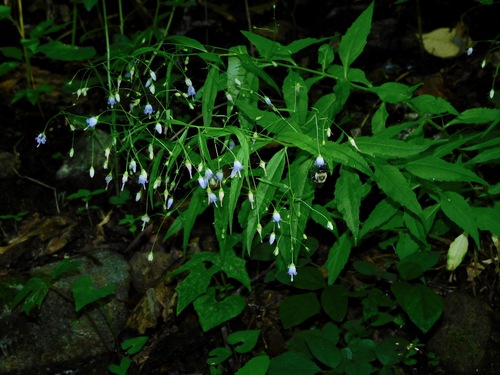
The Southern Harebell (Campanula divaricata) is a charming perennial wildflower native to the rocky, dry, and wooded slopes of the Appalachian Mountains. Known for its delicate, airy structure, this plant features slender, widely branching stems that support a multitude of tiny, nodding blue-to-violet bells. It brings a touch of delicate beauty to rugged, dry habitats where other plants might struggle to survive. Unlike many larger, showier garden bellflowers, the Southern Harebell possesses an understated elegance. Its blooms dangle downward like miniature woodland lanterns, dancing in the mountain breeze from mid-summer into early autumn. This resilient wildflower plays an important role in its native ecosystem, providing a vital source of nectar for late-season pollinators navigating rocky slopes and forest edges.
Habitat: Typically found on dry, rocky slopes, cliffs, ledges, and open acidic woodlands within the Appalachian region.
The Southern Harebell is characterized by its thin, wiry, and highly branched stems that typically grow between 30 and 90 centimeters tall. Alternating along the stems are narrow, lance-shaped leaves with sharply toothed margins. The most defining feature is the abundance of small, dangling, pale blue to lavender-blue bell-shaped flowers, measuring about 5 to 8 millimeters long. The petals of these tiny bells flare outwards and curl back at the tips, exposing a long, straight style that conspicuously protrudes past the rim of the flower like a tiny bell clapper.
Category
PlantsRarity
Common
Danger
1/5 · Very low
Snaps
Be the first to snap!
Its blossoms are so light and delicate that they appear to float in a blue mist when viewed from a distance against dark rocky cliffs.
The specific epithet 'divaricata' means 'widely spreading' or 'straggling,' referring to the plant's highly branched, airy flowering stems.
Unlike many garden bellflowers, the style (female reproductive part) of the Southern Harebell protrudes far outside the bell, resembling a tiny clapper in a real bell.
The downward-facing flower design protects the delicate pollen and nectar from being washed away or diluted by heavy mountain rainstorms.
Pollen is deposited onto the growing style before the female stigma matures, ensuring efficient transfer to visiting bees while preventing self-fertilization.
Its fibrous root system locks into shallow, acidic soil pockets within rock crevices, allowing it to withstand dry, windy mountain conditions.
As a photosynthetic plant, the Southern Harebell produces its own organic compounds using sunlight, carbon dioxide, water, and soil minerals.
Bombus vagans
Collects nectar and pollen, acting as one of the primary native pollinators of the harebell.

Odocoileus virginianus
Browses on the leaves and stems of the plant, especially in areas with high deer density.
No trait badges are assigned for this object yet.
No aliases listed yet.
Collections for this object will appear here as more themes are added.
Danger
1/5 · Very low
No special safety notes yet.
Start with the whole plant, then compare leaf arrangement, leaf edges, stems and any flowers or fruit. Opposite leaves grow in pairs; alternate leaves come one at a time along the stem. These details tell you far more together than a single green leaf does. Plant Identifier: upload a photo and compare the visible details.
30-90 cm
3-10 years
As a photosynthetic plant, the Southern Harebell produces its own organic compounds using sunlight, carbon dioxide, water, and soil minerals.
Typically found on dry, rocky slopes, cliffs, ledges, and open acidic woodlands within the Appalachian region.
Zoom in to split clusters and explore where this object has been snapped.
Recent snaps will appear here as new observations are added.
Take the discovery with you
Snap it with Snappit to identify it, learn what makes it special, and add the discovery to your collection.