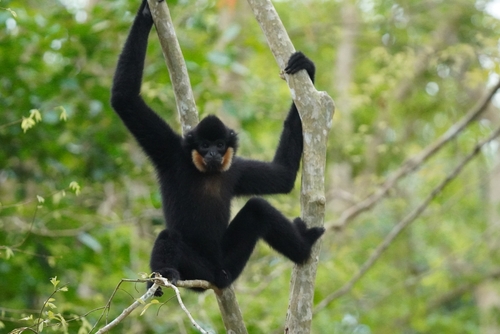


Southern Yellow-Cheeked Gibbon
nomascus gabriellae
The Southern Yellow-Cheeked Gibbon is a captivating lesser ape native to the lush, tropical canopies of Vietnam, Cambodia, and Laos. Renowned for its incredible agility and spectacular vocal displays, this highly arboreal species lives in tight-knit, monogamous family groups. They defend their territories through elaborate, coordinated "duets" sung at sunrise, which echo through the misty canopy to reinforce social bonds and warn neighboring groups. As vital components of their forest ecosystems, these gibbons act as key seed dispersers, consuming vast quantities of fruit and depositing seeds far from parent trees, promoting forest regeneration. Observing them navigate the treetops with effortless grace is an unforgettable experience.
Habitat: Typically found in the high, continuous canopies of primary and mature secondary tropical rainforests.
This species exhibits striking sexual dimorphism and color changes as they mature. Infants are born with a bright buff-blonde coat, which darkens to black in both sexes by about one year of age. Upon reaching sexual maturity, males remain completely black except for prominent, bright golden-yellow or orange patches on their cheeks. Females, conversely, turn back to a warm blonde or light-buff color, often accented with a small black cap on the crown of their head and dark extremities, making adults of each sex exceptionally easy to distinguish.
Category
MammalsRarity
Common
Danger
1/5 · Very low
Snaps
Be the first to snap!
Like humans, gibbons do not have tails, which distinguishes them from monkeys.
Their spectacular singing is assisted by a specialized throat structure that acts as a resonator to amplify their calls across kilometers of dense forest.
They are among the few monogamous primates in the world, often staying with the same partner for life.
Using incredibly long arms and hook-like hands, they swing through the canopy at speeds up to 55 km/h, leaping gaps of over 10 meters.
Mated pairs perform highly complex, coordinated vocal duets at dawn to mark territory and strengthen their pair bond.
When walking on top of wide branches, they raise their long arms high above their heads to maintain perfect balance.
Primarily frugivorous, they favor sugar-rich ripe fruits but easily supplement their diet with young leaves, flowers, and occasional insects.
Age differences: Infants nurse exclusively on breast milk for the first six months before gradually transitioning to solid fruits and leaves.
Ficus racemosa
Disperses the seeds of the Cluster Fig tree through consumption and excretion, promoting forest regeneration.
Neofelis nebulosa
Preyed upon by the elusive Clouded Leopard in the upper canopy.

Macaca fascicularis
Competes for seasonal fruits and space within the high canopy.
No trait badges are assigned for this object yet.
No aliases listed yet.
Collections for this object will appear here as more themes are added.
Danger
1/5 · Very low
No special safety notes yet.
Compare ears, muzzle, tail, feet and coat markings. Size is hard to judge without something nearby for scale, and young mammals may not have adult coloring yet. Mammal Identifier: upload a photo and compare the visible details.
45-65 cm
5.8-8 kg
25-45 years
55 km/h
Primarily frugivorous, they favor sugar-rich ripe fruits but easily supplement their diet with young leaves, flowers, and occasional insects.
Typically found in the high, continuous canopies of primary and mature secondary tropical rainforests.
Foraging
Zoom in to split clusters and explore where this object has been snapped.
Recent snaps will appear here as new observations are added.
Take the discovery with you
Snap it with Snappit to identify it, learn what makes it special, and add the discovery to your collection.