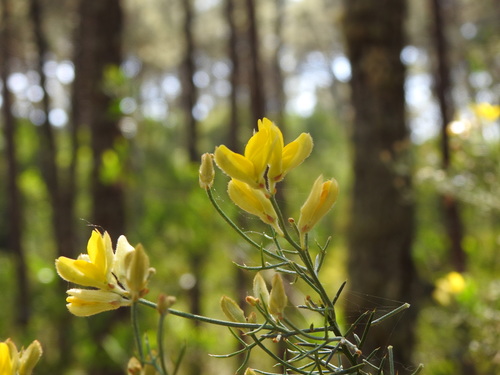


Stauracanthus Genistoides
stauracanthus genistoides
Stauracanthus genistoides is a striking, spiny shrub native to the sandy coastal areas and heathlands of the southwestern Iberian Peninsula. Belonging to the legume family (Fabaceae), this resilient plant is perfectly adapted to the harsh, nutrient-poor conditions of Mediterranean dunes. It plays a vital role in its ecosystem by stabilizing loose sands and enriching the soil through nitrogen-fixing root nodules. During its peak blooming season, it transforms the arid landscape with a brilliant display of golden-yellow flowers, contrasting sharply with its formidable green spines.
Habitat: Found in coastal sand dunes, pine woodlands, and inland heathlands with acidic, nutrient-poor soils.
This erect, highly branched shrub typically grows between 40 to 150 cm in height, forming dense, cushion-like thorny thickets. Its most distinctive feature is the cross-like arrangement of its stiff, sharp green spines (modified branches or cladodes) which function in place of leaves to minimize water loss. In spring and early summer, it produces bright yellow, pea-like flowers approximately 1 to 1.5 cm long, which cluster heavily near the tips of the branches and are eventually followed by small, hairy seed pods.
Category
PlantsRarity
Common
Danger
1/5 · Very low
Snaps
Be the first to snap!
Because it lacks traditional broad leaves, almost all of the plant's photosynthesis takes place directly within its green, woody spines.
It acts as an ecological pioneer, stabilizing shifting sand dunes and creating sheltered microhabitats where more delicate plants can take root.
The genus name Stauracanthus comes from the Greek words 'stauros' (cross) and 'akantha' (thorn), referencing the distinct cross-like pattern of its spines.
Houses symbiotic bacteria in its roots, converting atmospheric nitrogen into usable soil nutrients to thrive in sterile sands.
Has replaced traditional leaves with needle-like photosynthetic spines to drastically reduce water loss during hot Mediterranean summers.
Possesses a robust underground root system capable of quickly regenerating new shoots after coastal wildfires.
Produces its own energy through photosynthesis, utilizing sunlight, carbon dioxide, water, and soil minerals while fixing its own nitrogen.
Apis mellifera
Pollinated by worker bees collecting nectar and pollen from the yellow flowers.
Rhizobium leguminosarum
Fixes nitrogen in the roots through a mutualistic relationship with specialized soil bacteria.

Oryctolagus cuniculus
Provides cover and nesting habitats, and is occasionally browsed by wild rabbits.
No trait badges are assigned for this object yet.
No aliases listed yet.
Collections for this object will appear here as more themes are added.
Danger
1/5 · Very low
No special safety notes yet.
Start with the whole plant, then compare leaf arrangement, leaf edges, stems and any flowers or fruit. Opposite leaves grow in pairs; alternate leaves come one at a time along the stem. These details tell you far more together than a single green leaf does. Plant Identifier: upload a photo and compare the visible details.
40-150 cm
5-15 years
Produces its own energy through photosynthesis, utilizing sunlight, carbon dioxide, water, and soil minerals while fixing its own nitrogen.
Found in coastal sand dunes, pine woodlands, and inland heathlands with acidic, nutrient-poor soils.
Zoom in to split clusters and explore where this object has been snapped.
Recent snaps will appear here as new observations are added.
Take the discovery with you
Snap it with Snappit to identify it, learn what makes it special, and add the discovery to your collection.