
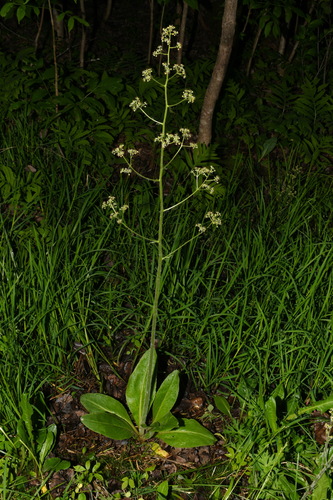


Swamp Saxifrage
micranthes pensylvanica
Swamp Saxifrage, Micranthes pensylvanica, is a resilient herbaceous perennial belonging to the Saxifrage family. This fascinating plant thrives in challenging wetland environments across eastern North America, where it plays an important ecological role. Known for its ability to grow in saturated, often nutrient-poor, and sometimes acidic soils, it stands as a testament to adaptation. Its early spring bloom provides a vital nectar source for early emerging pollinators, signaling the awakening of the wetland ecosystem. Despite its somewhat unassuming appearance, the Swamp Saxifrage is a crucial component of its unique bog and fen habitats.
Habitat: Found predominantly in various wetland habitats, including bogs, fens, swamps, wet meadows, sedge hummocks, and along stream banks in cool, perpetually moist to saturated soils.
This plant forms a basal rosette of large, oblong to spatulate leaves, typically 10-30 cm long, with irregular, wavy-toothed margins and often a slightly wrinkled texture; they are generally dark green. From the center of this rosette emerges a tall, leafless flower stalk, reaching 30-90 cm in height, which is usually glandular-hairy and purplish-green. The inflorescence is a narrow, elongated panicle composed of numerous small, greenish-white to yellowish-green flowers, each with five petals and ten stamens, giving the overall bloom a somewhat fuzzy or frothy appearance.
Category
PlantsRarity
Common
Danger
1/5 · Very low
Snaps
Be the first to snap!
Its genus name "Micranthes" means "small flower," referring to its numerous, though individually tiny, blossoms.
Its hairy stems are often covered in sticky glandular hairs, which may deter small crawling insects or aid in water retention.
Swamp Saxifrage is an indicator species for certain types of high-quality wetlands, meaning its presence often indicates a healthy and undisturbed ecosystem.
The species name "pensylvanica" refers to Pennsylvania, one of the states where it was first documented or is prominently found.
It possesses specialized root systems that tolerate anaerobic (low oxygen) conditions common in saturated soils, allowing it to thrive where many other plants cannot.
As an early spring bloomer, it is well-adapted to cooler temperatures and can emerge and flower even when frost is still a threat, providing early resources for pollinators.
It propagates effectively through short, thick rhizomes, enabling it to form colonies and persist in its specific wetland niches, even if individual plants are disturbed.
Swamp Saxifrage produces its own food through photosynthesis, converting sunlight into energy. It absorbs essential nutrients and water from the saturated, organic-rich soils of its wetland habitat.
various Brachycera
Pollination
various Apidae/Halictidae
Pollination

Odocoileus virginianus
Herbivory

Sphagnum spp.
Habitat interaction
No trait badges are assigned for this object yet.
No aliases listed yet.
Collections for this object will appear here as more themes are added.
Danger
1/5 · Very low
No special safety notes yet.
Start with the whole plant, then compare leaf arrangement, leaf edges, stems and any flowers or fruit. Opposite leaves grow in pairs; alternate leaves come one at a time along the stem. These details tell you far more together than a single green leaf does. Plant Identifier: upload a photo and compare the visible details.
30-90 cm
0.05-0.2 kg
3-10 years
Swamp Saxifrage produces its own food through photosynthesis, converting sunlight into energy. It absorbs essential nutrients and water from the saturated, organic-rich soils of its wetland habitat.
Found predominantly in various wetland habitats, including bogs, fens, swamps, wet meadows, sedge hummocks, and along stream banks in cool, perpetually moist to saturated soils.
Foraging (nutrient Absorption)
100-5000
Zoom in to split clusters and explore where this object has been snapped.
Recent snaps will appear here as new observations are added.

Massachusetts, US
You might spot Eastern Newt, Purple Pitcher Plant, and Hobblebush.
View guide →

Wisconsin, US
You might spot Sundial Lupine, Canadian Lousewort, and Cream Wild-Indigo.
View guide →

Missouri, US
You might spot Rose Vervain, Three-Toed Box Turtle, and Christmas Fern.
View guide →
Take the discovery with you
Snap it with Snappit to identify it, learn what makes it special, and add the discovery to your collection.


















