

Tall Blacktip Ragwort
senecio atratus
The Tall Blacktip Ragwort (Senecio atratus) is a striking perennial herb native to the high-elevation meadows and rocky slopes of the western United States. Growing robustly in the challenging alpine and subalpine zones, this member of the aster family stands out with its tall, leafy stems capped by clusters of vibrant yellow flower heads. It plays an important role in stabilizing loose montane soils and providing nectar to specialized alpine pollinators. Despite the harsh mountain winds and intense solar radiation, this resilient plant thrives where few others can, utilizing specialized chemical defenses to deter herbivores. Its presence adds a splash of brilliant color to the rugged, stone-filled landscapes of the Rocky Mountains. Naturalists and hikers often encounter it along high-altitude trails, where it serves as a beautiful indicator of a healthy, undisturbed montane ecosystem.
Habitat: Typically found on high-elevation rocky slopes, talus fields, subalpine meadows, and open coniferous forests.
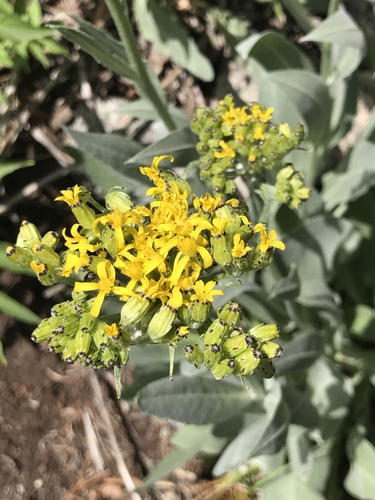
This species is a tall, erect perennial herb reaching 30 to 100 centimeters in height. Its sturdy, ribbed stems are leafy and may have sparse, woolly hairs when young. The leaves are broadly lance-shaped with coarsely toothed margins, often pale green to grayish-green. The defining visual characteristic is its dense, flat-topped clusters of narrow, cylindrical yellow flower heads. Each flower head is wrapped in a cup of green bracts (phyllaries) that feature distinct, starkly contrasting black tips. The flower heads mostly consist of disk florets, though a few short, inconspicuous yellow ray florets may sometimes be present at the outer edges.
Category
PlantsRarity
Common
Danger
1/5 · Very low
Snaps
2
It is incredibly hardy, often growing directly out of cracks in solid rock and scree fields above the tree line.
The common name 'blacktip' refers to the distinct, charcoal-black tips on the bracts surrounding each flower head, resembling miniature painted matchsticks.
The toxic alkaloids in this plant are preserved during drying, allowing picas to store them in haypiles where the toxins decay slowly, keeping the food fresh for winter.
Produces toxic secondary metabolites that deter herbivores and insects from feeding on its foliage.
Features fine, woolly hairs on young leaves and stems to trap moisture and protect tissues from freezing alpine temperatures.
Develops a deep, sturdy taproot system that anchors the plant securely in unstable talus and rocky soils.
As an autotrophic plant, it produces its own food through photosynthesis, converting sunlight, water, and carbon dioxide into sugars.
Bombus huntii
Feeds on nectar and serves as a major pollinator for the flowers.
Ochotona princeps
Harvests the plant for winter haypiles, utilizing the plant's toxic alkaloids as a natural preservative.
No trait badges are assigned for this object yet.
No aliases listed yet.
Collections for this object will appear here as more themes are added.
Danger
1/5 · Very low
No special safety notes yet.
The easiest way to identify Tall Blacktip Ragwort is to use the Snappit nature identifier app.
30-100 cm
3-10 years
As an autotrophic plant, it produces its own food through photosynthesis, converting sunlight, water, and carbon dioxide into sugars.
Typically found on high-elevation rocky slopes, talus fields, subalpine meadows, and open coniferous forests.
100-1000
14-30 days
Zoom in to split clusters and explore where this object has been snapped.
Take the discovery with you
Snap it with Snappit to identify it, learn what makes it special, and add the discovery to your collection.












.jpg&width=800)



_001.jpg&width=800)




