
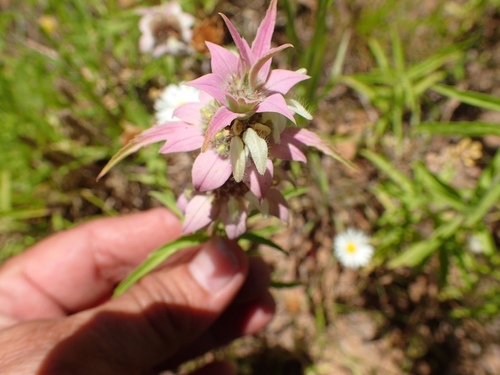


Texas Sandsheet Beebalm
monarda fruticulosa
Monarda fruticulosa, commonly known as the Texas sandsheet beebalm, is a rare and striking perennial subshrub endemic to the deep sandy soils of southern Texas. Belonging to the mint family, Lamiaceae, this resilient plant is celebrated for its highly aromatic foliage, which releases a pleasant, spicy, oregano-like scent when bruised or crushed. It stands out in its arid, harsh environment by producing dense, tiered clusters of pale pink to white flowers nestled within prominent, colorful bracts. Adapted beautifully to the shifting sands of the Texas gulf coast and inland dunes, this plant plays a crucial role in its local ecosystem by acting as a primary nectar source for a variety of native pollinators, including specialized bees, butterflies, and hummingbirds. Its tough, woody base allows it to anchor the loose sands, making it an ecological anchor in a delicate habitat.
Habitat: Found restricted to the deep, loose sands and sand dunes of the South Texas sandsheet and surrounding Rio Grande Plains.
This perennial subshrub typically grows up to 30 to 70 centimeters tall, featuring a somewhat woody base and erect, grayish-green square stems covered in fine, velvety hairs. Its narrow, lance-shaped leaves are oppositely arranged along the stem with slightly serrated margins. The most distinctive feature is the stacked, spike-like whorls of tubular, two-lipped flowers which range in color from pale lavender and pink to nearly white, often dotted with tiny purple spots. These blossoms are cradled by broad, showy bracts that can display pinkish, whitish, or purplish tints, making the flower clusters highly conspicuous.
Category
PlantsRarity
Common
Danger
1/5 · Very low
Snaps
Be the first to snap!
It is a narrow endemic, meaning it is native to a very specific, small geographical region and found naturally nowhere else in the world.
Like many members of the mint family, its leaves contain thymol, giving them a strong oregano-like scent when crushed.
The stacked, multi-tiered flower clusters are called 'verticillasters', resembling miniature green and pink pagodas.
Develops a deep, branching root system that stabilizes the plant in loose, shifting sands while accessing moisture deep underground.
Features fine, reflective puberulent hairs on its leaves and stems that reduce water loss by reflecting sunlight and trapping a micro-layer of humid air.
Produces volatile essential oils, including thymol, which deter herbivores and possess strong antimicrobial properties to prevent infection.
As a photosynthetic plant, it generates its own energy from sunlight, water, and carbon dioxide while drawing essential minerals from the sandy soil.
Bombus pensylvanicus
Provides nectar and pollen to native bumble bees, which assist in pollination.

Danaus plexippus
Visits the flowers for nectar, facilitating pollination during migration.
Schizachyrium scoparium var. littoralis
Competes for water and space in the sandy coastal prairie habitat.
No trait badges are assigned for this object yet.
No aliases listed yet.
Collections for this object will appear here as more themes are added.
Danger
1/5 · Very low
No special safety notes yet.
Start with the whole plant, then compare leaf arrangement, leaf edges, stems and any flowers or fruit. Opposite leaves grow in pairs; alternate leaves come one at a time along the stem. These details tell you far more together than a single green leaf does. Plant Identifier: upload a photo and compare the visible details.
30-70 cm
3-8 years
As a photosynthetic plant, it generates its own energy from sunlight, water, and carbon dioxide while drawing essential minerals from the sandy soil.
Found restricted to the deep, loose sands and sand dunes of the South Texas sandsheet and surrounding Rio Grande Plains.
Photosynthesis
Zoom in to split clusters and explore where this object has been snapped.
Recent snaps will appear here as new observations are added.
Take the discovery with you
Snap it with Snappit to identify it, learn what makes it special, and add the discovery to your collection.


















